
9 Common Pottery Wheel Mistakes and How to Fix Them
Pottery, like any art form, does not have a specific set of rules. Creativity knows no bounds, and you can never go wrong with your creation. However, it does not mean that you can just go ahead and craft whatever you like. You may not have to work within pottery-making rules, but you must familiarize yourself with the nature of Clay and the way it reacts.
It takes years to become a master in Pottery, and just like anything you learn, you can expect to make mistakes along the way.
Before you hit the Wheel and work on your next piece, here are some common mistakes that new potters make. I have compiled these 9 mistakes in hopes that they will help you improve your pottery throwing skills.
Affiliate Disclaimer: We are ambassadors or affiliates for many of the brands we reference on the website. As an Amazon Associate, I earn from qualifying purchases.
Mistake #1: Not Wedging the Clay Properly

If there’s one thing that Potters can agree upon, it is that wedging is the least fun but the most important part of Pottery Making. Many people have never done it before, so they would take out a manageable amount of Clay from the bag, pat it into a ball, and then throw it onto the Wheel.
Trying to get away with not wedging your Clay and thinking it’ll save you time can be counterintuitive. Improper wedging can make your Clay difficult to work with or hard to center.
If it feels like a constant battle just to keep your Clay centered, you may have an air pocket in it. Air is lighter than Clay, and if you’re working with air pockets, or even a single large one, in your Clay, it will always throw your Clay off-center.
Not wedging correctly will introduce more air pockets rather than remove them. The only thing you can do is take it off your Wheel, start over, and wedge another piece of Clay correctly.
Before you start throwing, make sure your Clay has a consistent moisture level. It shouldn’t have hard spots and maintain a smooth feel throughout your Clay. Sure, it can be tedious, but it is a vital part of making Pottery. There’s no way around it, but if you want to make throwing easier, you should never skip this step. For more on Wedging properly, go to How To Wedge Clay A Beginner’s Guide With A Step By Step Video or check my Article on The Three different ways you can Wedge your clay.
It shows three different wedging methods to help you choose the one that works best for you.
Mistake #2: Using The Wrong Clay
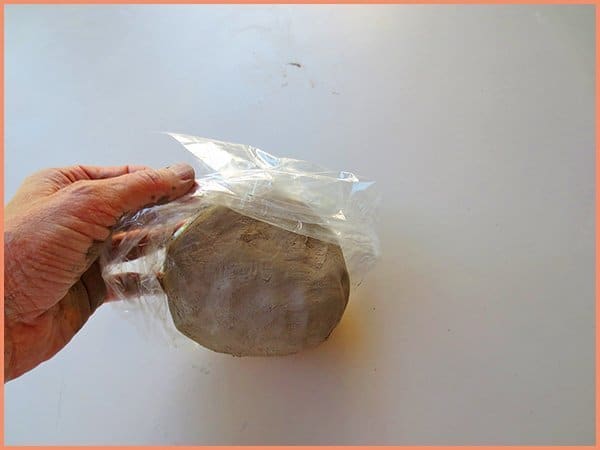
If you’re throwing on the Wheel, and your piece feels like sandpaper against your hands, you’re most likely using the wrong Type of Clay. There are types of Clay that you can use for throwing on the Wheel, while others are better for hand-building.
Although you can use any type of Clay when on the Wheel, not all of them will be easy to shape or center. Remember, when throwing on the Wheel, your piece needs to be smooth enough to work with you, not the other way around. If it feels like sandpaper or you feel like you’re exerting too much effort while molding your Clay, you will most likely have the wrong Clay.
What Type of Clay to Look For
If you’re a beginner throwing on the Wheel, it’s best to look for strong and smooth Clay with little to no grog or sand. A clay with this property may take longer to center, giving you more time to pull up the wall. But if your clay is too soft, your piece will collapse faster.
If you’re hand-building, you can use more grog or sand to make the Clay strong enough to hold up your piece. For beginners, I suggest the Amaco Buff Stoneware Clay 46 because it’s easy to use on the Wheel and works well for hand-building.
Don’t use clay with too much grog or sand when throwing. More grog or sand means the Clay will stay up longer, but it also feels like coarse sandpaper and hurts your hands.
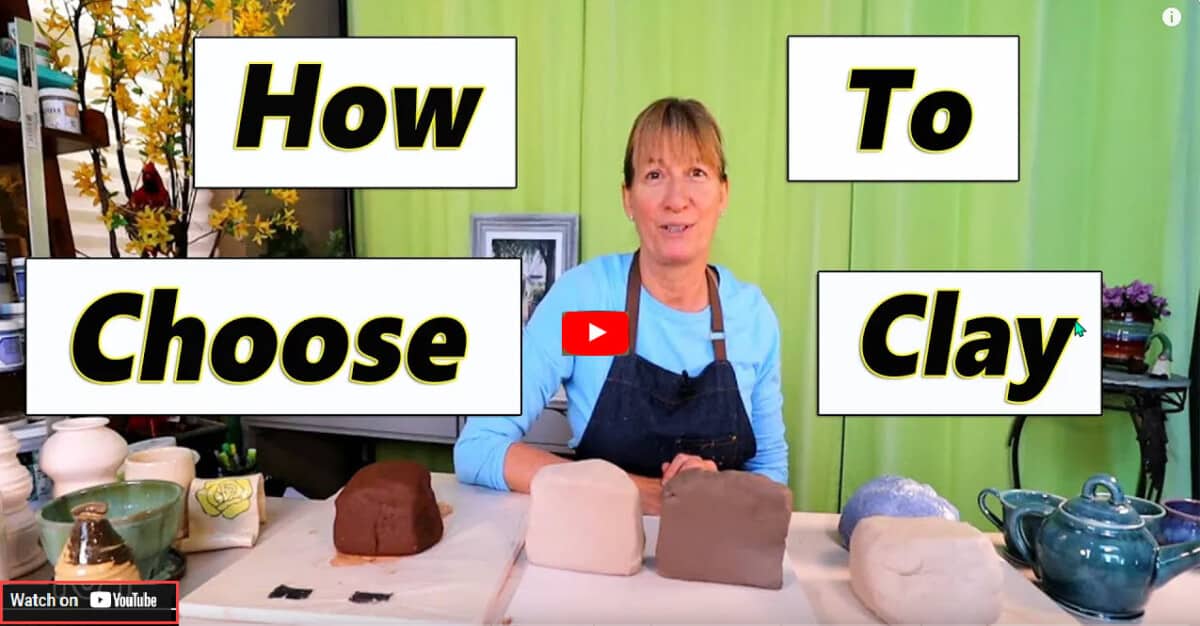
The number of clays available can be overwhelming when you’re just starting to learn Pottery. Check out Choosing Your Pottery Clay – Best Pottery Clay For Beginners. It will help you find Clay that stays firm longer, is user-friendly, and is robust enough for building walls, making it much easier for you to make Pottery. I also have a Video below on choosing your Pottery Clay for you to check out.
Mistake #3: Water Issues On Clay (Too Wet or Too Dry)
Water issues are the most common mistakes made by novices and seasoned potters. If you’re working on Clay that’s too dry and hard, you will find it almost impossible to get it centered on the Wheel, and if you do, it’s not easy to form. On the other hand, too much water will make it easy to center your Clay and just as easy for your Clay to collapse when pulling up a wall.
Fortunately, water issues are the easiest mistakes to spot and fix. When working on Clay, you want it to be easy to form. It should neither be too soft that you can’t shape it nor too dry that you can’t get it centered. If you feel like you’re struggling with your Clay, you’re most likely dealing with water issues.
Mistake #3.1: Not Enough Water on your Clay
If you craft pieces using Clay that doesn’t have enough water, you will have smoothness problems. It is not fun to work with and generally makes molding harder.
When working with Clay, make sure it doesn’t feel dry in your hands. You also need to pay attention to how it molds; if you’re struggling to work with it, then you’re not using enough water.
I struggled for a long time until I realized my Clay was too dry and hard. It didn’t matter how much water I added to it on the Wheel; the Clay was still hard in the center. The best way to deal with dry Clay is to take it off the Wheel and introduce more water. Wedge the water into your Clay until it’s malleable (workable) throughout.
Clay that has enough moisture is easy to use and soft enough to mold to your will. A piece with enough water will stay centered on the Wheel without exerting too much effort.
If you feel that your Clay doesn’t have these properties, there are two things you can do;
- Take it off the Wheel and add more water to your Clay. Spray water on and wedge it out. Continue until it’s soft enough to throw.
- Let your Clay dry to bone-dry, then recycle it. If you are unfamiliar with recycling bone dry clay, read Recycle Bone Dry Clay In 6 Easy Steps – With A Guided Video. I found this method to be so easy, saving me so much Clay over the years.
Mistake #3.2: Too Much Water on Your Clay
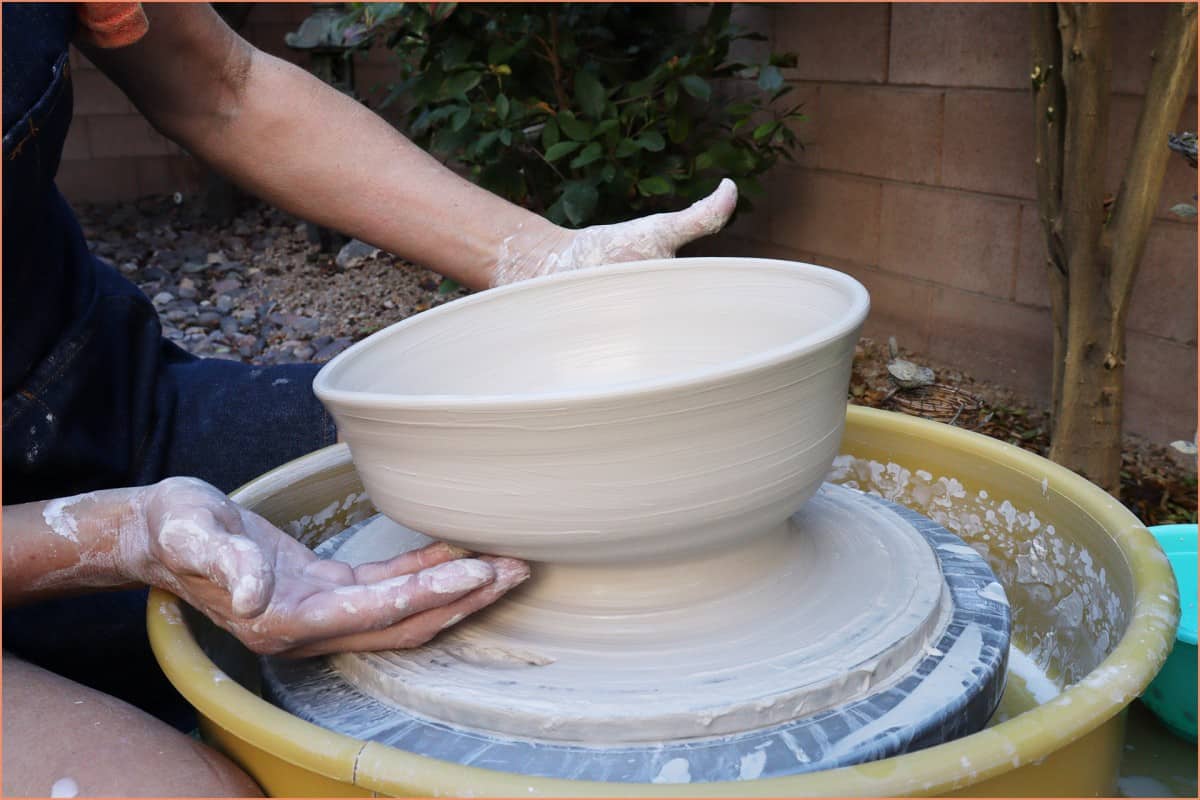
Having too much water on your Clay is just as common as not having enough. It could be that your Clay started that way, or that you’ve added too much water.
Just like not having enough water, Clay that is too soft will be easy to center but tough to shape. If you use too much water with Clay, your piece may lose its shape before you finish.
When my Clay was too soft, it was easy to center, but not so good for throwing on the Wheel.
Before placing your Clay on the Wheel, wedge it. If it feels firm enough to shape it, you have the right consistency for your Clay. If it doesn’t feel right, here are two things that you can do to fix this issue:
- Look for an absorbent hard surface where you can wedge the excess water out. I prefer wedging on a wood or plaster surface because it absorbs water.
- If wedging didn’t work, you can flatten the Clay and lay it on a drying board, wood, or plaster. This method will take time, so you’ll need to remove a new piece and wedge it properly to achieve the consistency you want for your Clay. I recommend checking your flattened Clay every 15 minutes.
This mistake may be common, but easy to fix. Always remember: you want your Clay to have some moisture, but not a soggy, mushy, oversaturated piece.
Mistake #4: Body Positioning & Arm Placement
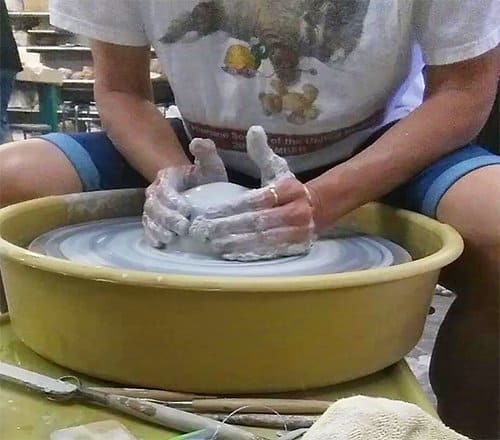
There are times when you have the best possible clay, and you’ve wedged it properly, but it still feels too hard to center or shape. If this is your case, you may be using the wrong body positioning and arm placement.
Arm placement is an important technique you need to learn when throwing on the Wheel. Still, it won’t feel natural without proper body positioning. So, before you start throwing, follow these tips:
- Position your legs as close to the splash pan as possible.
- Keep your back straight and your arms anchored to your thighs or the side of your body.
- Move with your upper body, not just your hands and arms.
- Lean in and over your Clay, keeping your back straight.
Anchoring your arms to your thighs or sides will provide support and give you enough control while centering. Always remember that making Pottery doesn’t require much strength, just proper positioning technique.
When working with your Clay, always follow these arm placement tips;
When centering Clay
- Pull your elbows toward your body
- Keep your body firm and back straight, and be mindful of your elbows.
- Firmly apply pressure on the Clay without using too much strength
- Hold the Clay on the side firmly with your anchor hand and control the Clay with your other hand in the karate position.
When pulling up your walls
- Continue to keep your back straight
- Be mindful of the position of your arms. Don’t lock them against your body.
- Keep your hand and finger positions consistent throughout
Centering becomes more difficult with your elbows up in the air. This position only means one thing: you have less control over your Clay. If you position your arms correctly, it’ll be a lot easier for you to work on the Wheel.
There’s no real benefit to applying too much force other than just tiring yourself quickly. So always focus on the position of your arms and hands to apply the right amount of pressure with your upper body to center and form the Clay more easily.
Mistake #5: Pressing Too Hard On Your Clay
When Centering
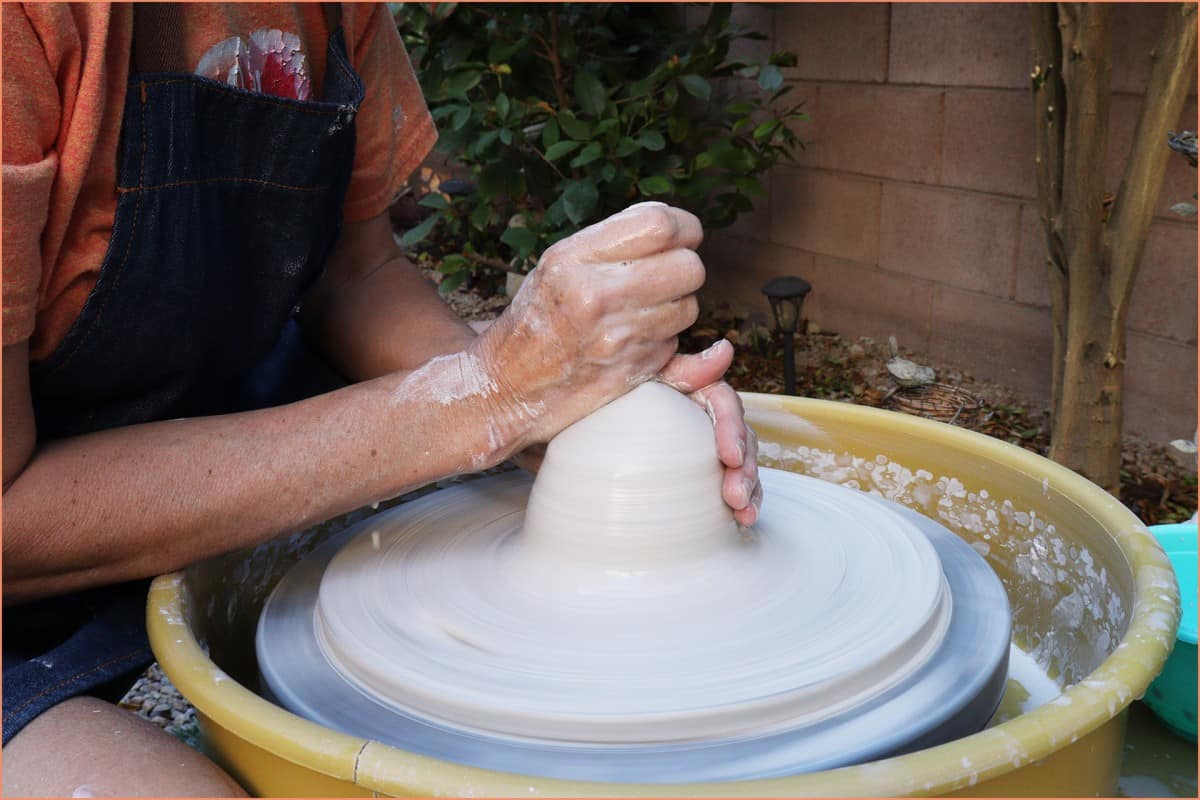
Clay is soft, and if you’re new to pottery making, it may feel like you have to use force just to keep it centered. The problem is, if you’re exerting too much effort pushing on the side with your anchor hand, you’ll keep throwing the clay off-center and wear yourself out.
One common misconception is that it requires a lot of energy and that throwing Clay on the Wheel is strenuous. The truth is, you don’t need a lot of strength when making Pottery. You just have to let the process take its course naturally and use your upper body.
When pulling up the walls

If you press your fingers too hard on your Clay, it can become uneven quickly. The Clay can get too thin on the top, bottom, or even middle if you squeeze too hard. Keep your fingers firm and consistent, applying even pressure as you pull up the walls. Be mindful not to squeeze or press your Clay too hard. This will help keep your cylinder even.
To find a good throwing clay, check out my Best Clays. These are clays I found to be very workable and have a nice smooth feel as you are throwing.
Mistake #6: Your Cylinder Collapses When Pulling Up the Walls.
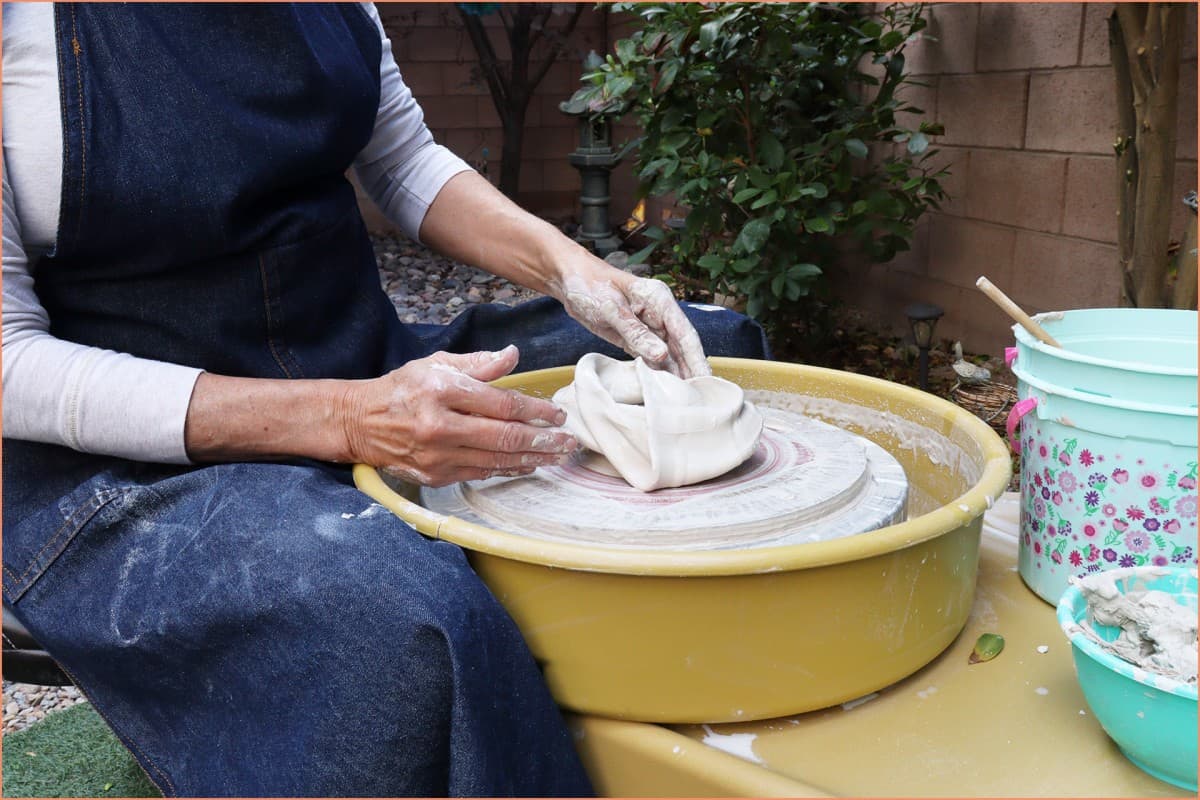
Forming a Cylinder is the ultimate test of patience and skills. It’s arguably the best moment when throwing on the Wheel. But what happens if it collapses or is uneven when you are pulling up the walls? Most people who are new to pottery-making can fall prey to these mistakes.
Let’s take a look at a few reasons why your cylinder collapses;
Uneven pressure
Don’t squeeze your fingers too hard or too close together as you pull up your Clay.
Anchoring your left thumb against your right hand helps keep the pressure of your fingers consistent on the sides and the thickness even throughout your piece.
Using too much water and softening your Clay.
Most beginner potters use a lot of water. That’s to be expected. Even a pro will use a lot of water, but there is a simple fix. Use your sponge from time to time to remove excess water. Then use your metal scraper to remove the slip from the sides. Then you can reintroduce water, as you compressed the clay particles, helping keep your Clay stronger and longer.
Uneven walls.
This happens when there is more Clay on one side of the cylinder than the other. There are several reasons this can occur.
One is that you are not applying even pressure, which makes your Clay lopsided.
The second is that your Clay is not centered correctly. If your Clay is off-center, your piece will follow. If you are having trouble with centering your clay, READ 11 Problems Centering Clay and Easy Ways to Fix Them. I also have this VIDEO Centering Clay – 11 Problems – 11 Easy To Follow Solutions that could help.
Mistake #7: Trying to Open the Clay Too Fast
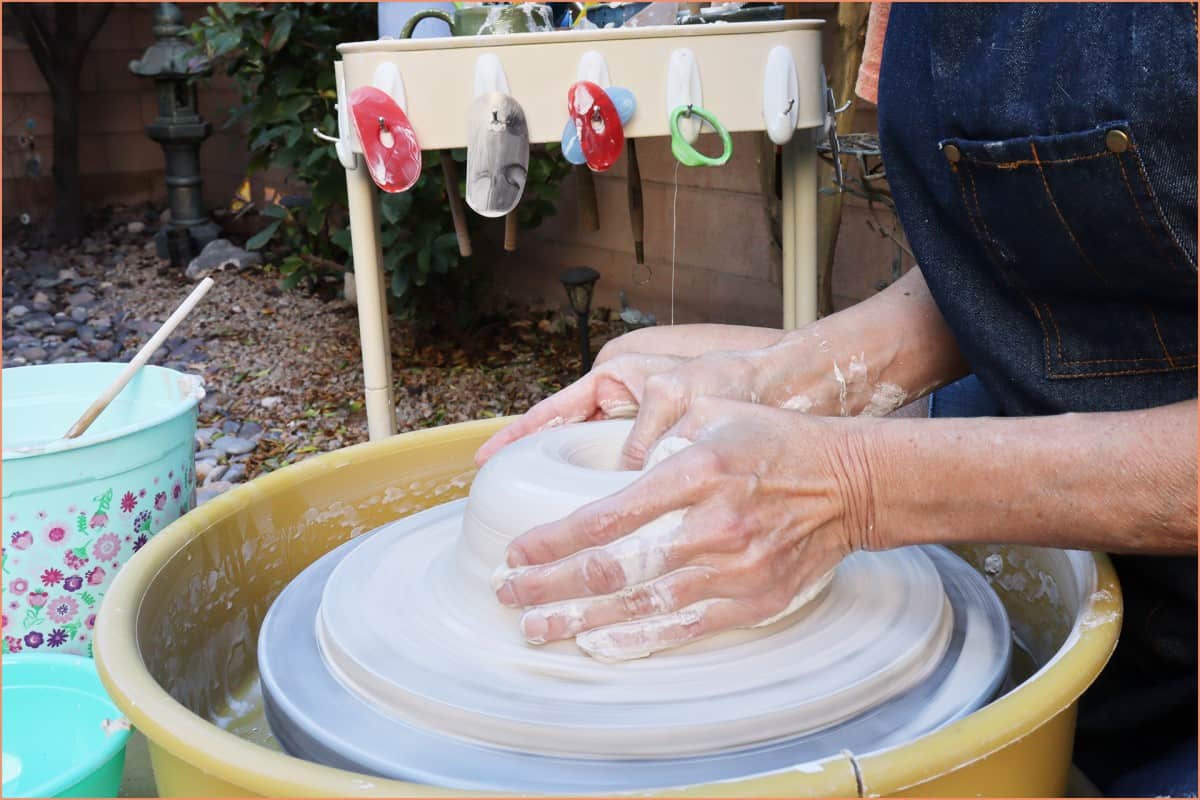
Rushing on things when making Pottery is never a good idea. This is especially true when trying to open up the Clay. Some potters tend to push their finger down into the center too quickly, which is a big mistake — so big that there’s no way to fix it.
Pushing your finger into the center too quickly will create a deep hole in your piece, making the bottom flimsy and forcing you to start again!
You have to open up the Clay slowly and let the Wheel’s rotation do the work for you. Slowly opening your piece will allow you to create the perfect size inside, with a balanced distribution of Clay for the wall. Here are some steps that you need to take to be successful with this process:
- Dip your fingers into the bowl or pail of water.
- Position your thumbs at the center of your Clay.
- Push down on the Clay to start opening.
- Then, place your anchor hand on the side of the Clay and push down with your fingers to continue opening.
- Don’t apply too much force.
- When you feel your fingers start to dry up, dip them again into the bowl or pail of water.
- Repeat the process until you reach near the bottom of the Clay.
- Beginners should always use a needle tool to ensure they don’t go down too far.
Opening up your Clay takes a little practice, but is easy once you get the feel of the Wheel and the Clay. Pottery may seem like a physical activity, but the secret is patience. Professional potters don’t mold Clay with force; they let the rotation and gravity do the work.
Mistake #8: Wheel Speed (Too Slow or Too Fast)
When it comes to Wheel speed, one speed does not fit all. Different speeds are used for several reasons. When you’re new at making Pottery, you can either take off like a bullet or go so slow it’s hard to create anything. Throwing on the Wheel becomes much easier when it Rotates at the Proper Speed at the Proper Time.
When learning to throw on the Wheel, we sometimes go too slow or way too fast. Countless times I would either hear the teacher say, “slow down your Wheel,” or “if you go any slower, your Wheel will stop.”
Too Slow
There are times when you need to slow down your Wheel, but not for centering your Clay. If your Wheel is going too slow when trying to center, you will find your Clay is moving you instead of you moving the Clay.
This problem can be quickly fixed: Speed up your Wheel to at least medium-high to give you more control over the lump of Clay and center it faster.
If you’re trying to pull up your walls and your Wheel is going too slow, you will struggle. Speeding up your Wheel to medium speed or a little less will help you create a nice piece of Pottery.
Too Fast
If your Wheel moves too fast when bringing up a cylinder, it can quickly turn into a bowl.
The faster your Wheel moves, the faster the cylinder wants to flare out, as it naturally does under the centrifugal force of the spinning wheel.
This problem can also be quickly fixed: Slow your Wheel down to medium speed or a little less, and collar the cylinder with both hands.
I’ve seen professional potters create beautiful pieces, moving the Wheel slowly and fast.
The more you throw on the Wheel, the speeds will come naturally to you. Remember, if you go too slow, you have less control over the Clay, and if you go too fast, your Clay can spin out of control.
Once you get your Clay centered, a good rule of thumb is to stay at a med or med-low speed until you find the speed that’s best for you. Pottery (just like any form of art) doesn’t have a specific set of rules. Some guidelines can help you with your pottery crafting journey.
Mistake #9: Clay cracks as it dries
You’ve just made this beautiful piece of Pottery. You take it off the Wheel and set it aside to dry. Once it has dried or has been bisque-fired, you notice a crack or two, and your heart sinks. The cracks can occur on the bottom, the rim, or even where you applied your handle.
The bad news is these cracks are hard to fix. It’s so hard that most of the time, you will end up having to make another piece. The good news is there are a few things you can do to Help Prevent these Cracks.
Compress your Clay
When making anything on the Wheel, the #1 thing to do is to compress your Clay. I always compress the bottom and rim throughout, making my Pottery. This technique works every time for me. Whenever I have rushed through or neglected to do it, that’s when an S crack arrived.
Slow Drying
When you dry your Pottery, slow is the best way to go. Place your piece on a drying board or ware board to dry. Cover with plastic for at least the first day to slow the initial drying and help prevent cracks.
Wax resist
If you have any problems with cracking when you attach handles or anything else to your Pottery. Brushing wax resist around the attached area helps your Clay dry more slowly and prevents cracking as it dries.
Doing all three will increase your chances of avoiding those nasty cracks that ruin your Pottery. I rarely get cracks, but when I do, it is always because I didn’t compress my clay or I dried my piece too quickly.
You can also read about How Long Pottery Should Dry Before Firing to prevent your pottery from cracking in the kiln.
Conclusion
Patience and practice are the keys to becoming a successful Potter. Sure, you may hit beginner’s luck on your first try, but it takes patience and practice to perfect the art of Pottery. Knowing the right texture for your Clay and applying the correct pressure takes time to master.
Always remember that making Pottery is not a skill that you can learn overnight. The techniques you can use to perfect your craft will come as you push your creative boundaries. Let’s stay dirty.