

Buying a Pottery Kiln | Facts Features and What to Consider
Hobbyists seeking electric kilns to fire earthenware pottery or slip-cast ceramics will find the market flooded with options. However, not all of these kilns are suitable for the job.
When purchasing a Kiln, there are certain factors to consider. Electric Kilns tend to be more popular than Gas-fired options because they produce different, brighter colors with Oxidation firing. While some colors, like copper red, turn out better when fired in a Gas (reduction) Kiln, many Potters opt for an Electric option.
Carefully researching before purchasing your first or next Electric Kiln can help you choose the right one, whether you produce a few pottery pieces a month or are looking to establish a pottery business. This guide examines six popular electric kilns suitable for your home studio, featuring kilns that offer exceptional power and efficiency.
Affiliate Disclaimer: We are ambassadors or affiliates for many of the brands we reference on the website. As an Amazon Associate, I earn from qualifying purchases.
6 Popular Home Studio Kilns
- Skutt Kilnmaster – KM-1227-3
- Amaco Excel Kiln with EZ-Lift – EX270SF
- Amaco Excel 22” Deep Single Phase Kiln – EX-329SF
- Skutt Kilnmaster – KM-818
- Skutt Kilnmaster – KM-614-3
- Skutt FireBox 8×6 Kiln
However, before we discuss these Kilns, we need to cover the features that a good electric pottery kiln should have.
What Do You Need in a Good Pottery Kiln?
A good pottery Kiln will ideally offer even heating, be easy and safe to use, and last for many years to come.
Supports Higher Temperatures
Stoneware and porcelain typically need higher temperatures. Bisque and Glaze firing normally requires temperatures ranging from around 1789°F (976 °C) Cone 07 to 2345°F (1285 °C) Cone 10.
Porcelain, Stoneware, and Porcelain glazes work best in even higher temperatures. You want your kiln to reach 2345°F (1285°C; Cone 10). The reason is that even if you fire lower, a Cone 10 Kiln will fire more efficiently and last longer. Also, if you ever want to or need to fire to Cone 10, you can do so. Again, you can always lower the Temperature of a higher-temperature kiln, but you can never Fire Higher with a Low-Temperature Kiln.
If you plan to fire low-fire earthenware clay and/or mid-fire stoneware or porcelain clay, a kiln that fires to Cone 6 will work fine for your needs.
Heating Elements and Bricks Designed for Even Heating
A good Electric Kiln for pottery should ideally have 3-inch fire bricks for Insulation. They are more energy-efficient, which is always a plus for your power bill.
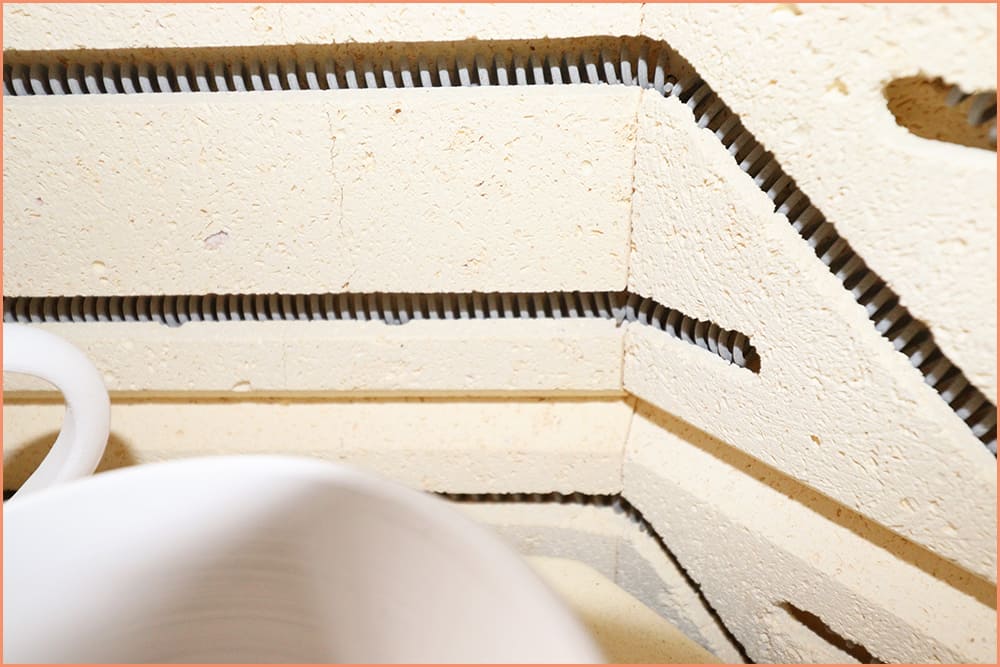
One of the limitations of Electric Kilns is that they use radiant heat from heating elements to fire your pottery. Because there is no circulation to distribute heat evenly throughout the piece, the section facing the heating element receives more heat than the section on the shady side. Heavier pieces of Pottery tend to be heated unevenly as a result. That’s why a 10-minute hold is recommended to ensure the whole kiln reaches the desired temperature.
Well-designed Thermocouple
The Thermocouple is the probe that measures temperature in the Kiln and sends temperature readings to and from the controller for accurate temperature readings. An expensive kiln may have type S platinum thermocouples that can last a decade or more, even at Cone 10 firings. These are made of platinum and rhodium.
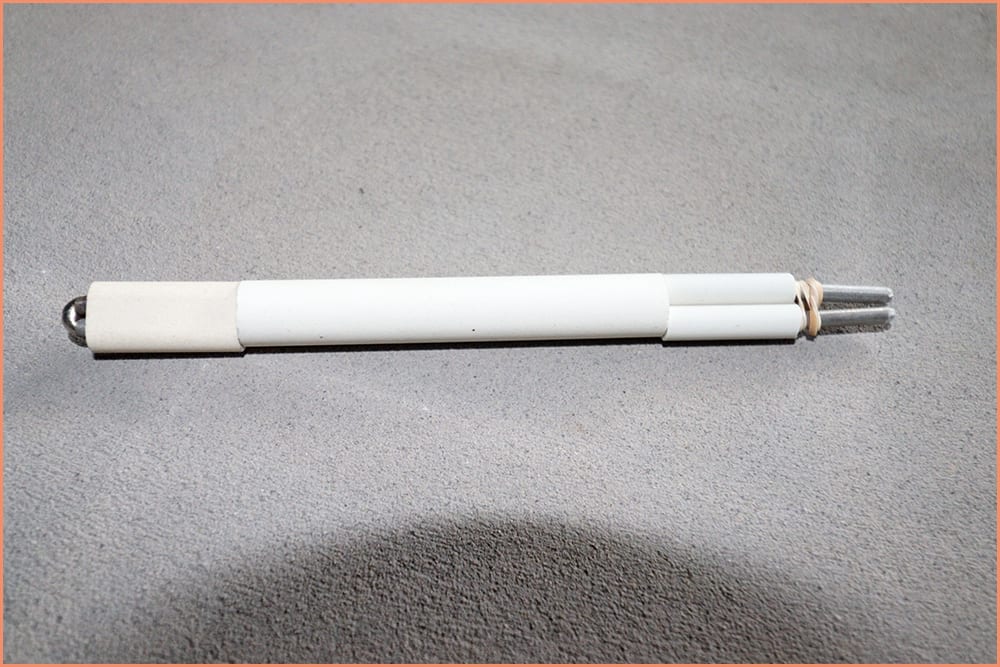
Most Electric Kilns, however, come with type K thermocouples. These are inexpensive and made of chromel and alumel. How long type K Thermocouples last depends on your firing schedule and the firing temperatures.
A Type that Fits Your Project
If you intend to fire up little ceramic animals as a hobby at home, a 27-inch Electric Kiln is a waste of space and money. At the same time, firing up thick porcelain pieces evenly on a Cone 8 Electric Kiln to perfection may be difficult. You should buy a Kiln that fits your needs. If you only make a few pieces in a week, how long do you want to wait until you have enough greenware to fill your Kiln?
Ergonomic Design
The ergonomic design means a Kiln that you don’t have to bend over too much to use safely. Top-loading models aren’t good for everyone. If you have a height disadvantage when facing deep, full-volume kilns, opt for a front-loading model. They are pricier, but you’re paying for the lack of a backache from bending over too much.
Many models come with a one-handed lid design. Such handles can be helpful if you intend to use your Kiln a lot.
Intend to move your Kiln around a lot? Look for models with wheeled stands. Most Kilns come with a stand that does not have wheels. Wheel stands are great space savers. You can wheel your kiln out for use and back against the wall when you are done.
Reasonable Price
Electric Kilns can range from $ 1,000 to $15,000, depending on a variety of factors. Usually, higher wattage, greater capacity, and better-quality heating elements mean a higher price.
Front-loading designs are typically more expensive. Top loaders are more popular. Paragon and Skutt are two popular brands to come out of the US with excellent industrial-standard kilns at surprising prices.
Paragon is recommended for you if you have a big budget. Skutt models are more competitively priced. Skutt is known for its thermocouples, and the brand’s industrial-standard models are highly affordable for their quality.
A Programmable Controller
Manual Controller:
Kilns can come with different types of controllers. Manual controllers are rare. These controllers require you to start your kiln at the lowest settings and manually adjust the temperature throughout the firing process. Note that manual controllers are not for beginners.
The Set-Pro Control:
The Set-Pro Control is a standard 3-button controller commonly found on many Electric Ceramic Kilns. Some people find that it doesn’t offer the same level of flexibility as 12-button or touchpad controllers. But the Set Pro is good for beginners or those on a low budget.
The KMT Controller:
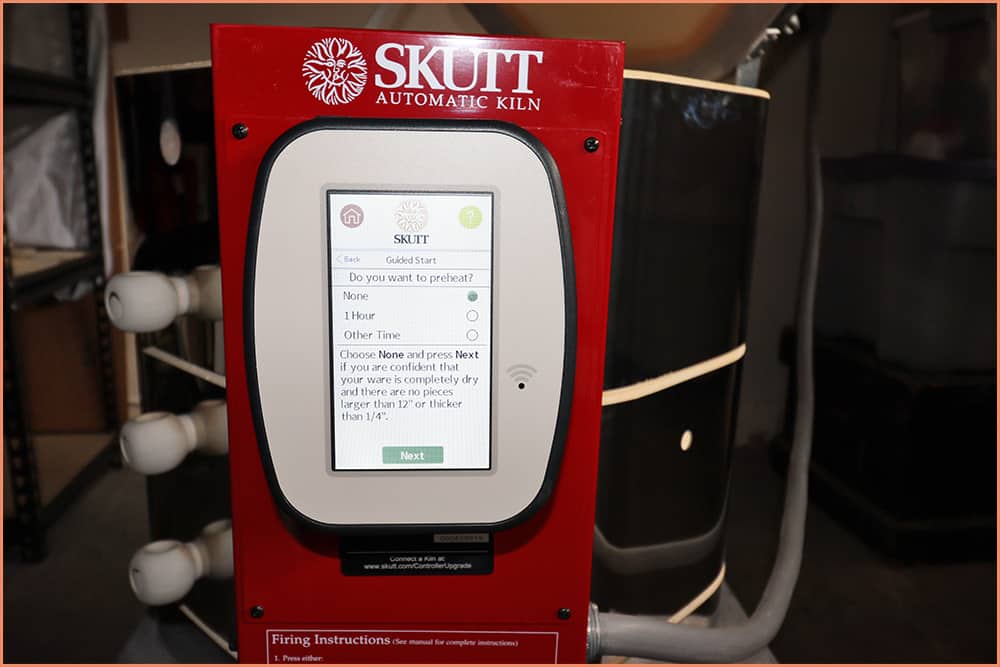
The KilnMaster by Skutt has a touchscreen controller similar to a smartphone, with built-in WiFi, that lets you upgrade your firmware whenever Skutt releases a new feature, giving you a new controller for the life of the kiln. I like the free App you can download and access directly to your phone. The App allows you to monitor the temperature of your Kiln and how long it’s been firing from anywhere you are. This touchscreen was designed with beginners in mind. It will guide you through the process until you learn more about it.
Select Fire Controller:
The Select Fire controller allows you greater control over your Firings. It’s two controllers in one. You can fire your own firing profile with multiple holds and ramps or by cone numbers. This is an easy-to-use controller.
You can order the Skutt KilnMaster Touchscreen Controller separately by clicking HERE
Well-Ventilated Unit and Switch-Housing
You don’t want fumes and moisture to build up inside the Kiln during firing. This can rust the insides of the unit and affect the glaze.
A good Electric Kiln will have Vents to work as an exhaust. During the firing process, you’ll want to remove the top peeper to let the fumes out. You may also prop the top up with a piece of fire brick that Skutt supplies with the kiln.
A switch housing with a solid metal top will not provide good ventilation, which can lead to overheating. Ideally, the switch housing should have a metal grate or vents to allow airflow for cooling. Without airflow, the switches can overheat and fail.
Efficient and Suitable Kiln Furniture
A good Kiln manufacturer will offer high-quality furniture that heats quickly, retains heat as efficiently as possible, and maintains the desired temperature.
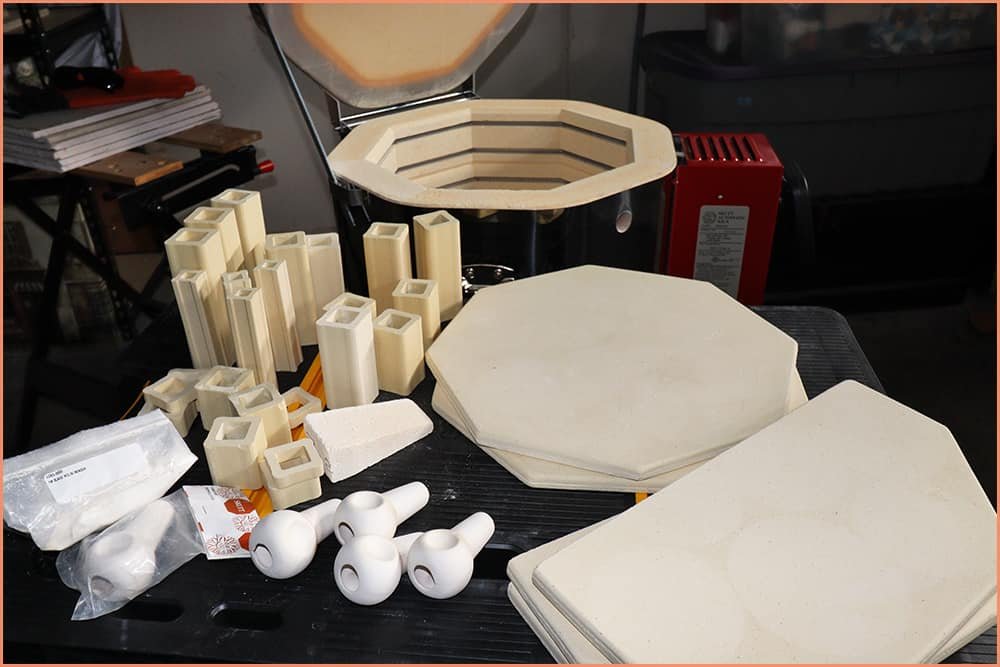
One of the reasons electric kilns can be inefficient is poorly designed Kiln furniture. Furniture includes bricks, shelves, bread racks (for wearable ceramics), Kiln posts, and stilts. Some materials are better than others. It’s best to order the furniture with your Kiln unless you want to pay for extra shipping charges later.
Here are a few things to keep in mind when choosing Furniture Materials:
- Kiln shelves are typically made of Cordierite, containing alumina and silica. They support firing up to Cone 10. But they tend to get warped beyond Cone 8.
If you plan to undertake many high-fire projects, look for high-alumina kiln shelves. But if you can afford them, silicon carbide shelves are the lightest and least likely to warp. You need to consider the weight, temperature rating, and size of the shelves for efficient and effective firing. - Support kiln shelves with Kiln posts. Using posts will maximize the space inside for the firing process.
What Are the Installation Safety Measures?
Install your kiln according to the manufacturer’s instructions and local fire and electrical safety codes. That is the area you never want to cut corners on.
Using a qualified technician keeps your insurance coverage valid, just in case something goes awry. When it comes to electricity, you should never take any chances.
I strongly suggest getting a Licensed Electrician to inspect and confirm that you can safely operate the kiln you are considering purchasing. I have found that HomeAdvisor.com is an excellent choice for hiring an Electrician to ensure the safe and correct installation of any wiring, breaker boxes, or outlets.
After signing up with HomeAdvisor, you will be connected with multiple contractors in your local geographic area.
You will then be able to ask your contractors questions to see if your Kiln is compatible with your electrical system before even setting up an appointment.
I had my Garage wired for my Skutt 818 Kiln, and it took less than one hour. Be Safe and get a Licensed electrician.
6 Popular Home Studio Kilns
Now that we’ve covered the basics, let’s take a look at the Electric Kilns for your Home or Small Studio, ranging from the larger to the smaller models.
Skutt Kiln Master KM-1227-3
This Skutt is a popular high-fire Kiln for larger pieces and higher production volume in your Home Shop or Small Professional Studio. The brand offers a vast range of low-fire to high-fire production Kilns. I have chosen the best-selling Skutt KM 1227 PK for several reasons.

This unit is larger, measuring 28.13 inches by 27 inches. It’s suitable for larger projects that require up to 9.9 cubic feet of volume.
This Kiln fires all the way to Cone 10. The precision Thermocouples increase the temperature accuracy and a host of other advanced features. Intermediate or seasoned users will appreciate the model’s many high-level features.
The unit comes with a multi-featured touchscreen that makes programming visual and intuitive. You can monitor the temperature and firing time status through your smartphone.
The Hinged Controller allows you to raise it, so you won’t need to get down on your hands and knees to program the unit.
The kiln is designed with parts that fit one another and can be removed for moving or replacing faulty sections. The extra investment you’re making in this design pays off in the long run for heavy-use cases.
The elements are designed for even heating across various zones, with twice as many grooves as most kilns of the same volume. There will be fewer cold spots when you use several shelves. The Skutt offers greater flexibility in use thanks to its element placement and design. Elements will last longer, too, when there is less burden on each one.
Thermocouples are exposed to greater accuracy. You can upgrade to Type S to buff up your Skutt. Additionally, the warranty on this model covers both labor and parts.
The
240 Volts requires an electrician to install a special plug for home use, so
Before buying, make sure you are equipped for it.
Pros
- The current sensor allows precision control and reading
- Sectional design for easy dismantling and repairs
- Balanced elements for more even heating and longer element life
- Exposed thermocouple for greater accuracy
- Industrial-grade wiring delivers 14,300 watts, ideal for a small production studio
- Plenty of upgrade options
Cons
- It does not come with a Touchscreen Controller with built-in WiFi.
- It may be too large for Home hobbyists or Small studios
To find out where to get your Skutt KMT 1227-3 Kiln and the current price, Click Here.
Amaco Excel Kiln with EZ-Lift – EX270SF
Another offering that provides more room for your home studio is the Amaco Excel high-fire Electric Kiln with EZ-Lift – EX270SF. The EX series is ideal for artist studios because it’s designed for larger pottery pieces and high-volume production.

The interior dimensions are 27 inches Deep and 23 3/8 inches across, with a firing area that measures 7.0 cubic feet.
The standard model comes with a convenient, accurate controller. The bottom and lid can be turned over to extend the life of your Kiln.
The kiln can achieve maximum temperatures of 2345 F (1285 C) or Cone 10. It is well-suited for advanced or intermediate artists working with ceramics. High-fire pottery up to Cone 10 requires artistry, and EX-353SF is known for delivering bisque and glaze firing to satisfaction.
This model runs on 240 volts. That may be more powerful than many home studios are equipped for. You will need an electrician to ensure you have enough amps and to install the proper plug.
To find out where to get your Excel Kiln with EZ-Lift – EX270S Kiln and the current price, Click Here.
Amaco Excel 22” EX-329SF
The Amaco Excel 22” EX-329SF is a reliable ceramic Kiln for a Small Studio or your Home Studio. This Kiln was designed to make loading easy for Potters who are unable to reach the bottom of the Kiln.

The Kiln weighs 155 lbs. and stands 36 inches high and 29 inches wide. The interior dimensions are 22 inches Deep and 17½ inches across, with a firing area that measures 3.2 cubic feet. The compact size makes it easy to make space for pieces to move around.
You get a 2 ½-inch brick construction for good temperature distribution, sturdy handle brackets, and a load-bearing hinge for strength; durable stands for heavy-duty use; and an ergonomic extra-wide handle for use with gloved hands.
The kiln can reach temperatures of 2381°F (1305 °C), which is great for artists working with high-fire Stoneware and Earthenware. If you can take advantage of its high power, you have a sturdy, reliable kiln that can deliver good performance.
Note that the 232SF requires 240 V. We recommend having an electrician ensure you have the equipment to safely accommodate higher-voltage appliances.
Pros
- Compact size with advanced features
- High power, ideal for stoneware and porcelain firing up to cone 10 – 2381°F (1305 °C)
- It comes with the Select Fire Controller for easy operation
- Sectional design for easy dismantling and repairs
- Peepholes to help control the airflow in and out of the Kiln
- Despite the top-loading design, the 22” Kilns are made for individuals with a shorter reach.
Cons
- The standard stand doesn’t have wheels. An Amaco wheel stand is not available.
- Only 2 ½ inch brick, but can also get 3-inch brick EX-329SF. Keep in mind you lose the cubic area.
To find out where to get your Amaco Excel 22” EX-329SF Kiln and the current price, Click Here.
Skutt KM-818-3
I have chosen the best-selling, smaller Skutt KM-818-3 for several reasons. If you’re looking for a Skutt Kiln more on the compact side, the Skutt KM- 818 -3 is a perfect choice. It is a popular high-fire Kiln for your small Home Studio or Shop. This Kiln fires all the way to Cone 10.

The unit is slightly smaller due to the 3-inch bricks for better insulation. It weighs only 145 pounds. The inside measures 16 ½ by 17 ½ inches, and the volume is 2.3 cubic feet.
The Skutt KM-818-3 offers 3-inch Brick insulation, which makes it more energy efficient but cuts your width from 17 ½ inches to 16 ½ inches, reducing it to 2.3 cubic feet.
This unit also comes with a multi-featured touchscreen with a Hinged Controller that makes programming visual and intuitive. You can monitor the temperature and firing-time status on your smartphone.
This compact Kiln is designed with parts that fit one another and can be removed for moving or replacing faulty sections. The 240 Volts requires an electrician to install a special plug for home use, so before buying, make sure you are equipped for it.
The elements are designed for even heating. This Compact Skutt offers greater flexibility in use thanks to its element placement and design. When each element is less burdened, it will last longer, too.
The KM-818-3 is priced reasonably. You get everything in this smaller version that you do with the larger models, along with the advanced features. Beginners and seasoned users alike will appreciate the model’s features.
Pros
- Fires up to Cone 10 at 240 Volts.
- The current sensor allows precision control and reading
- Sectional design for easy dismantling and repairs
- Balanced elements for more even heating and longer element life
- Exposed thermocouple for greater accuracy
- Industrial-grade wiring delivers 6400 watts, which is great for a small production studio
- Plenty of upgrade options
- Doesn’t take up much room
- 3-inch bricks offer better insulation
Cons
- It does not come with a Touchscreen controller with built-in WiFi
- The thermocouple is not in an ideal spot for arranging your shelves
- Because of its smaller capacity, loading may be tricky at times, like a jigsaw puzzle.
To find out where to get your Skutt KM-818-3 Kiln and the current price, Click Here.
Skutt KM -614-3
This is a good, small-sized Kiln for a Home Studio. It’s perfect if you always low-fire, and you can even mid-fire to cone 6.

You can fire pieces like bowls, plates, and pots in your Studio. This 6-sided Kiln comes with 3” thick sidewalls, bottom, and lid, making it 20% thicker than the standard 2 ½” thick bricks.
You can easily set the Skutt KM-614-3 up in your Home Studio. A 115-volt, 20-amp, and a 30-amp breaker may require an electrician to install a special plug for home use. Make sure you are equipped for it before buying.
This Kiln is on the lighter side, weighing 88 pounds. The external kiln height is 29 inches with the stand. The inside of this Kiln measures 11 inches wide by 13.5 inches high.
Pros
- It puts out 115 Volts and only 20 AMPS
- The current sensor allows precision control and reading
- Balanced elements for more even heating and longer element life
- Exposed thermocouple for greater accuracy
- Industrial-grade wiring delivers 2300 watts, which is excellent for a small production studio
- It doesn’t take up much room
- 3-inch bricks offer better insulation
Cons
- It only fires to cone 6 – 2232℉ (1222℃)
- Due to its smaller capacity, loading may be challenging at times.
To find out where to get your Skutt KM-614-3 Kiln and the current price, Click Here.
Skutt FireBox 8×6 Kiln
This Skutt FireBox is a Perfect Starter Kiln. It plugs into a standard household outlet. It uses 15 AMPS, 1800 watts, and a 20-amp Breaker. It will use about the same amount of electricity as a big microwave. It also has a UL safety listing.
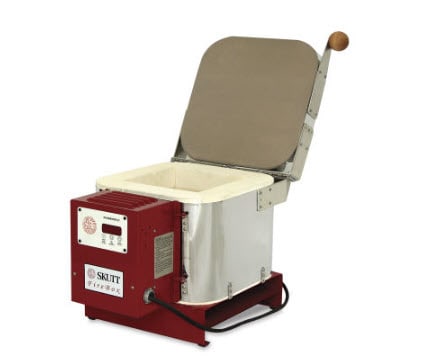
You can easily set the Skutt FireBox 8×6 Kiln in your Home Studio. You will need a well-vented area in your home away from any living area.
This little KIln reaches Cone 6 at 2232℉ (1222℃), which is enough for low- and mid-firing. The 8 x 8 inches across and 6 inches high is an ideal kiln for beginners who don’t make a lot of pottery yet, or if you only want to make small things.
Pros
- You can just plug it into the wall. No special wiring is needed
- It can be used for low- and mid-fire Ceramics.
- It is also a great test kiln
Cons
- It is a small Kiln that will only fit a few mugs
- It only fires to cone 6 – 2232℉ (1222℃)
To find out where to get your Skutt FireBox 8×6 Kiln and the current price, Click Here.
As your skills grow and you make more pottery and or larger pots, you can get an upgrade to a larger kiln and use this one as a test kiln for firing Test Tiles.
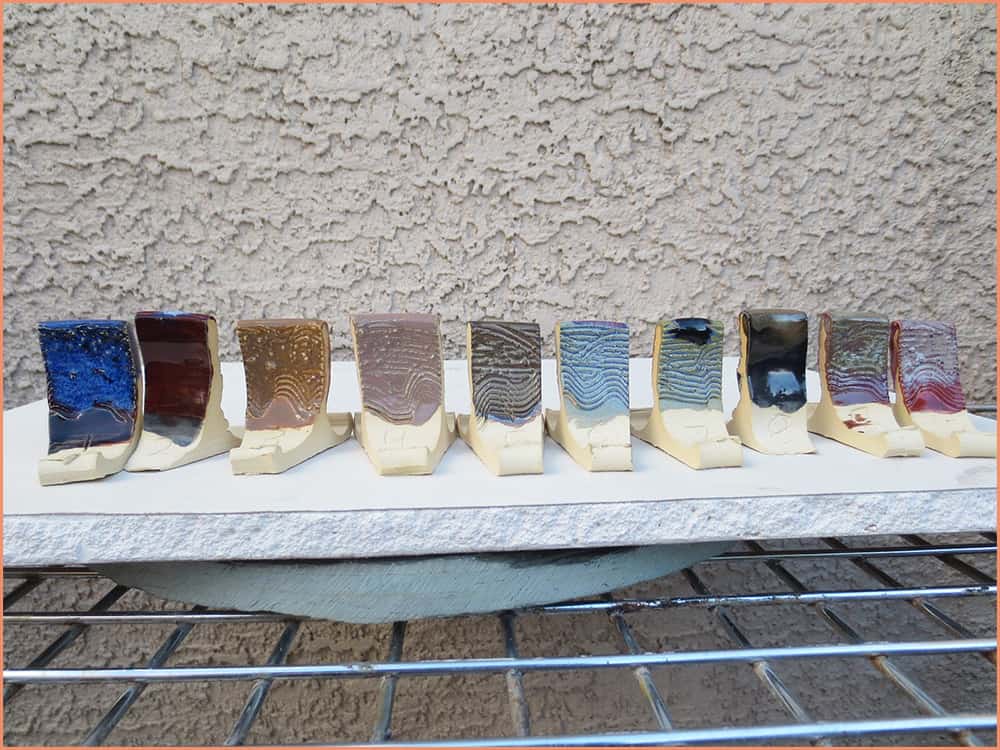
If you’d like to know how to make test tiles, I have a video for you here: Making Pottery Glaze Test Tiles – Wheel Thrown and Handbuilt.
Summary
Here are the key takeaways from this article:
- When buying an electric kiln for Low to High-firing Ceramic projects, look for robust Kilns with even heat distribution, an easy-access switch box, well-ventilated units, ergonomic design, and safety features. The most popular kilns for Home Studios and small production Studios offer these features.
- Choose a model with future-proofing in mind. The Skutt and Amaco Excel Kilns are great for Bisque and Glaze firing.
- I recommend the Skutt KilnMaster KM-1227PK for its industrial-quality parts that are easy to repair and replace. The Skutt is worth it, depending on usage. It is an excellent high-firing unit for your Studios.
- The Excel 22” Deep Kiln and Skutt KM 818-3 are great compact kilns, with the same high firing as the larger units. Easy to use and wonderful for smaller-scale or Hobby Use.
- If you prefer smaller starter Kilns, then the Skutt KM-614-3 or the Skutt FireBox 8×6 Kiln would be a great choice that will last you many years of use.