
Is Colored Slip the Same As Underglaze?
Pottery is a popular hobby, and because of that, Potters have developed a number of materials and mediums to decorate clay pieces. Among these, colored slips and underglazes are quite common. At first glance, both these materials can look pretty similar.
But is a colored slip the same as Underglaze? They are very similar in that both are liquid clay mixtures with added colorants like mason stains. The critical difference is the amount of clay, colorant, and frit (Frit is silica and flux). Colored slips contain higher clay content and no frit. Underglazes contain less clay content and a small amount of frit.
Now that you know the basic trait that distinguishes the two, let’s take a detailed look at their differences and ways of application.
Affiliate Disclaimer: We are ambassadors or affiliates for many of the brands we reference on the website. As an Amazon Associate, I earn from qualifying purchases.
Differences Between Underglaze and Colored Slip
Ingredients
The main difference between slips and underglazes is the Ingredients.
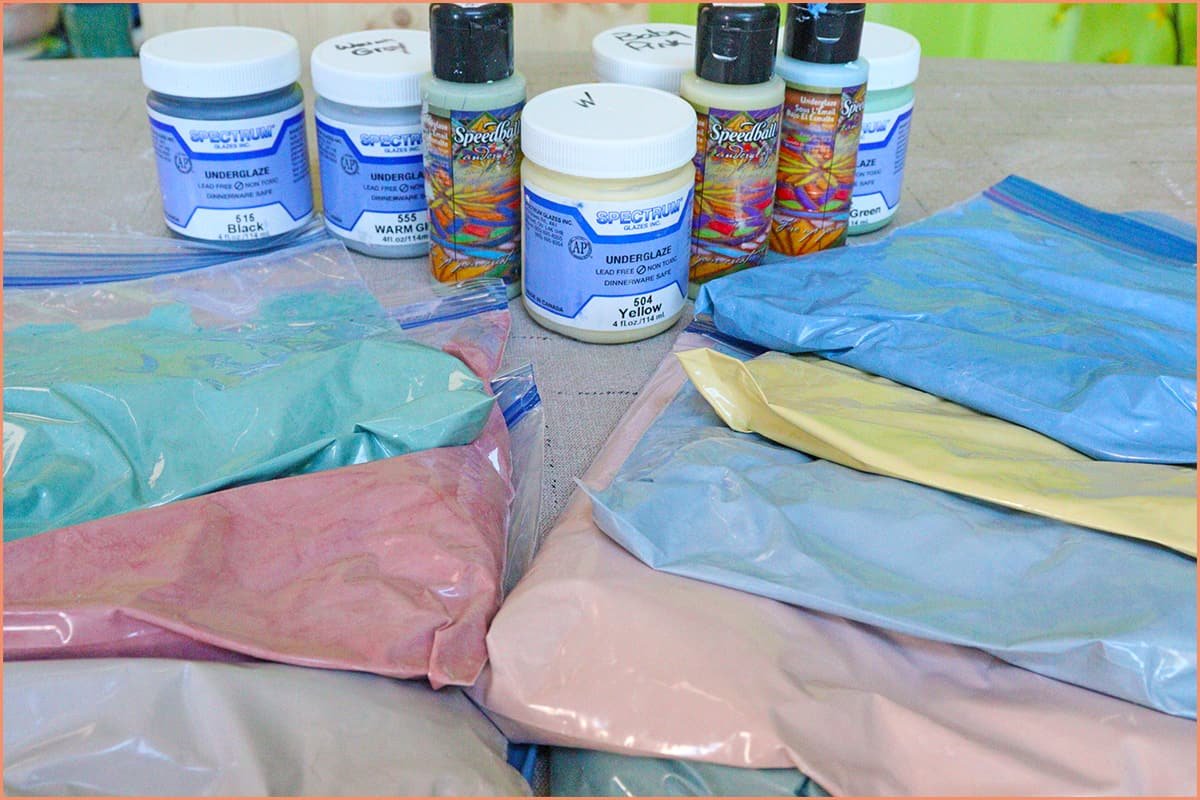
Underglazes contain less clay, more stains and oxides, and may contain CMC, Veegum, or both. The amount of clay, CMC, or Veegum depends on the underglaze manufacturer. Underglaze also contains a little Frit (a mixture of silica and flux), to help the underglaze fuse to the pottery.
Colored Slips consist of colorants like stains and oxides, clay, and water.
While slip and underglaze are similar, they are not the same.
Application
Underglaze can be applied at all stages of greenware and bisqueware because it contains Frit. Frit is a mixture of silica and flux that helps bond the underglaze to the pottery. But not enough to form a glass-like seal. Underglazes are also more suitable for thinner applications.
Colored slips are typically applied to leather-hard clay, but can also be applied to clay at any stage of greenware, as slip contains no melting agents, such as frit, for bonding to the bisqueware. Therefore, the Slip will most likely flake and/or peel off.
Colored slips can leave behind texture and thickness because they contain more clay. The amount of texture depends on how smooth and thick the clay is, as well as whether there is any sand or grog in your Slip. The application of colored slips can be thick or thin.
Color
The next key difference is found in colors. Underglazes have a wide range of colors that can be mixed easily. Commercial-colored slips have a smaller color range than underglazes. I made step-by-step Videos on How to Make Colored Slip and how to make Plain Slip. You can find them at the Bottom of This Page
To mix colored slips, add your own watered-down thinned clay and colorant like mason stains. Only compatible slips should be mixed together, i.e., Colored Slips designed for specific shrinkage rates and firing temperatures.
Additionally, Underglazes are available as pens, crayons, and pencils, as well as in liquid form, while colored slips are not. Underglazes can provide greater detail due to their lower clay content and small amount of frit.
Firing
Underglazes and slips stay in one place when fired.
Underglazes can have a specific firing temperature, so check the firing range before use.
Colored slips do have a specific firing temperature. Firing above that temperature will over-fire the Slip, causing bubbling and even melting. Always know the firing temperature of the clay content in your Slip.
Moreover, colored slips change their color during firing. The color comes out more after firing. You may think you didn’t add enough colorant, but keep in mind the color will come out more after it has been fired. Underglazes also come out more vibrant.
How to Apply Underglaze

Underglaze is mainly used for decorative purposes. It’s generally used to create colored patterns on clay. Underglaze can be applied in all stages of pottery-making: On greenware, from wet, leather-hard, and bone-dry to bisqueware. You could add more or less water depending on the condition of the clay.
Once the Underglaze has dried, a top layer of clear glaze is applied to the pottery before firing in the kiln to give a glossy finish and make the color permanent. Underglazes always retain their colors in the kiln. Their result is very predictable, and the designs are distinguishable.
Here are some valuable tips on applying underglazes:
- Once you’ve gotten the hang of Underglazing, try mixing different colors together. Mix primary colors like red, blue, yellow, white, and black together and see how many color variations and tones of these colors and secondary colors you can come up with.
- Underglazes should be layered if you want the result to pop when the piece is fired. The more layers you use, the less translucent your color will be. Building up color also adds depth and dimension to a piece.
- You can use a single underglaze layer to suit a muted piece. Muted colors are great if you want the clay color to be more prominent.
- Using a thin layer of Underglaze with a brush can give a watercolor effect. You can also get a drip effect by using slightly thinner Underglaze.
- Underglazes can be dipped in, painted on by a brush, or drawn with underglaze pens, pencils, and crayons. This lets you add fine details. You can also use Underglaze to Bubble Glaze, dip a String in the Underglaze to create a pattern, Scraffito, Mishima, Transfers, and Sponge Glazing.
How to Apply Colored Slip
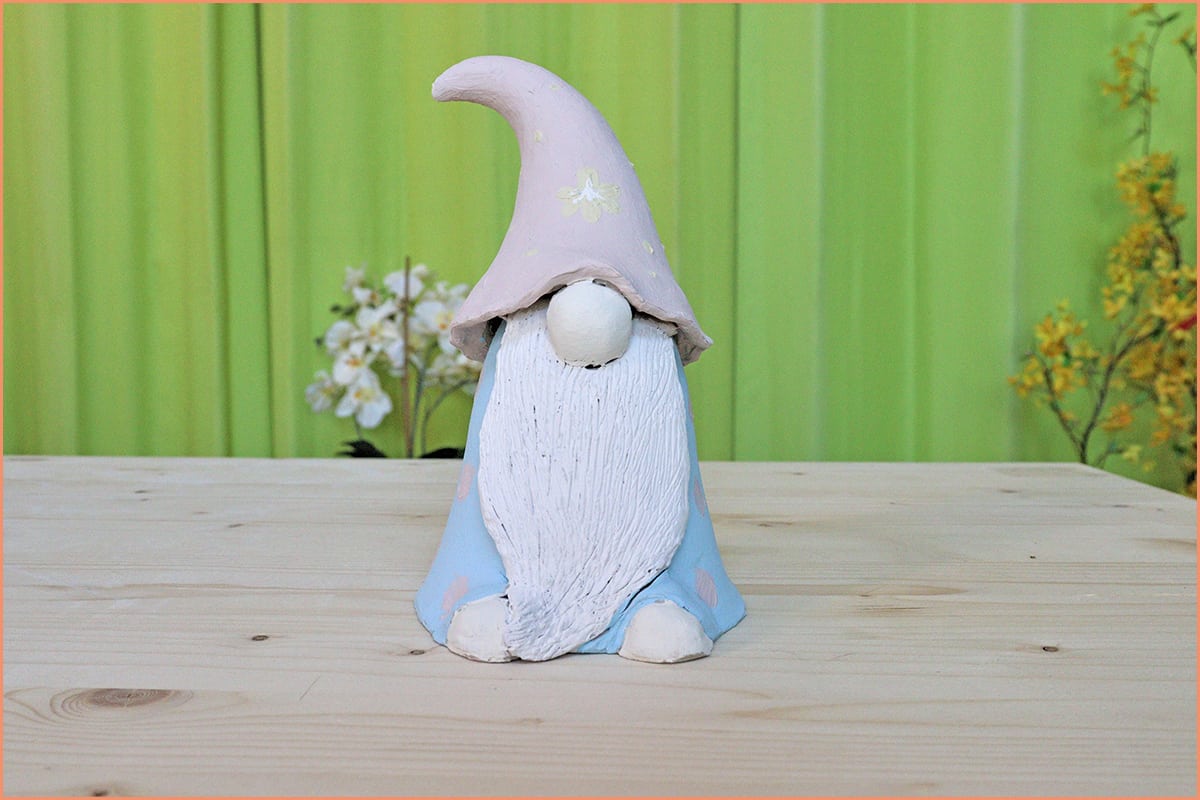
Colored slips also contain pigment-like underglazes and are generally used for decorative purposes.
Slips can be applied to all stages of clay, but remember to know the type of clay you are using for your colored Slip. When decorating, it’s best to use the same type of clay. This makes your slip and clay compatible, giving it the same shrinkage rate. That’s why it’s best to make your own Slip.
Here are a few tips on using slips:
- You can use slips as a gluing agent between two pottery pieces. It’s best if you use the same type of clay with the same shrinkage rate.
- Slip can be trailed on a pottery piece using a slip trailer, a small squeezable bottle with a nozzle. The Slip gives your piece wonderful results. You can use it to make elaborate patterns, too.
- Use a brush to paint on the colored Slip. You can either draw freehand or use a stencil.
- You can use colored slips in a unique way by applying them thick or thin. Once you’ve applied it, pick your piece up and swirl it around to create a pattern. Gravity plays an important role in this application method.
How to Use Underglaze and Colored Slip Together
Both Colored Slips and Underglaze can be used on a single pottery piece to achieve various complementary textures and colors.
The biggest difference is that Slip is made up of clay and colorant and will add more texture through the medium it’s worked with. Underglaze is made up of Clay, Colorant, and Frit and can have a smoother texture.
This difference in nature can be used creatively. You can use a colored slip to create an interesting pattern. The area will rise and have texture. You can use a thick or thinner Slip to create different patterns. After the Slip is totally dry, you can apply an underglaze on top.
There are so many different ways you can decorate with Slip and Underglaze. Have some fun with it. Experiment and see what beautiful decorations you can come up with. Just make sure your Slip, Underglaze, and Clay are compatible and have the same firing temperature.
I make a colored slip in This Video
I make a plain slip in This Video
Conclusion
Colored slips and Underglazes may seem like two different names for the same material, but they are different. Underglazes are easier to apply. They are better for more detailed designs and are beginner-friendly. Colored slips are just as much fun to decorate with once you get the hang of it.
Choosing between the two comes down to your needs. A good rule of thumb is to always check the label of your Clay, Slip, and Underglaze for the Firing or Cone temperature. If it does not say the firing temperature, do not buy it. With that said, have fun Underglazing and Slip decorating.