
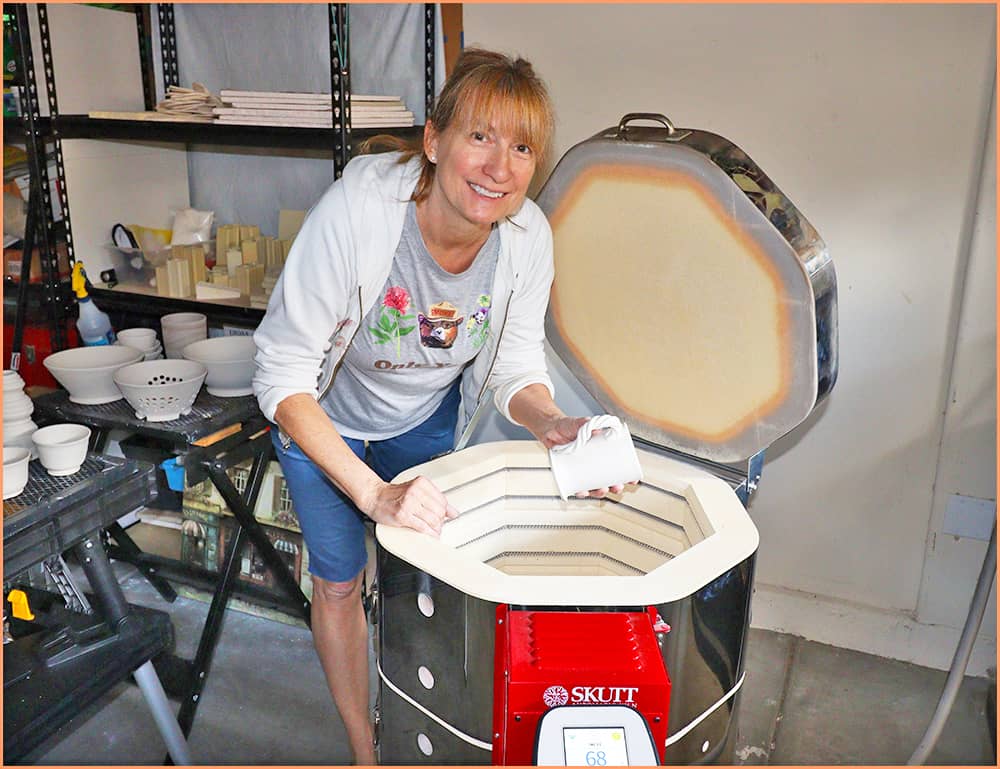
Choosing an Electric Kiln – A Step-by-Step Buyer’s Guide
Many expert potters recommend that beginners start with electric kilns rather than gas kilns. There are a few reasons for this:
- They can help a potter achieve consistent results with glaze.
- Electric Kilns are also more affordable and easier to operate in a home potter’s studio.
While there isn’t much of a difference between Kilns from one brand to another, there are certain criteria that will affect your Electric Kiln purchase.
A little research and prep work on Electric Kilns will make a huge difference to your buying experience. There are many different types in the market to confuse you. Start out with a list of selection criteria, and you’ll be happier with your purchase.
To help you choose the perfect Electric Kiln, we’ve started you off with a step-by-step guide below so you can make a better decision for your new home kiln. In a nutshell, these are the beginner-friendly steps to buying your Electric Kiln:
Alright, let’s dive right into it.
Affiliate Disclaimer: We are ambassadors or affiliates for many of the brands we reference on the website. As an Amazon Associate, I earn from qualifying purchases.
Step 1: Placement of Your Kiln
One of the factors you must consider when buying a kiln is the space you have for it.

Selecting Your Area
The gases that will fill the Kiln during a firing must be allowed to escape. No matter what you are firing, it is not a good idea to inhale these fumes in a closed room. This smart rule is a basic Kiln safety that you should follow.
Any firing produces carbon, water, and sulfur compounds. There may be a small amount of carbon monoxide mixed in with the carbon compounds. Sometimes, there may be metals present in the substance you’re working with. If the firing temperature is high enough, some heavy metals may be released into the air.
You should ideally keep the Kiln in a separate room from where you, your family, or your co-workers spend most of their time. You should ideally store it next to an external wall and a window or door open. This will help the Kiln vent properly. Most fumes from the clay and glaze will be released between 600°F and 1200°F (315 C to 648 C)
Measure the space available for the Kiln
Some beginners might want to keep their Kiln in a closet or in the corner of a small workroom. However, that isn’t recommended. Your Kiln (Depending on the size) should have at least 18 to 36 inches of clearance around it on all sides. Now that you know how much space you have for the Kiln, you can go ahead and look at the units in the market.
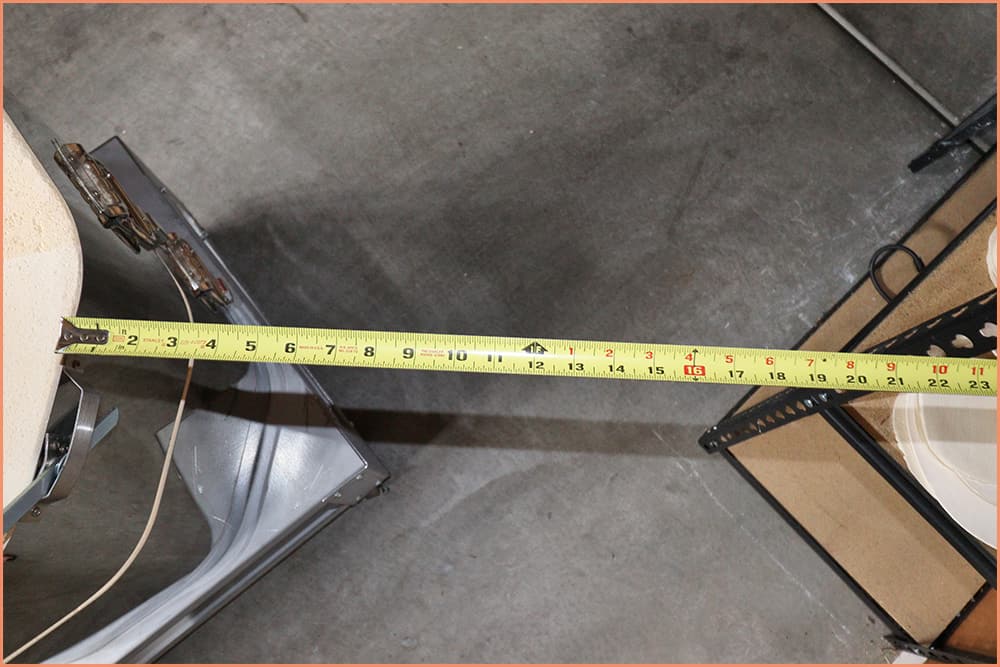
The smallest Kilns you can buy will be about 9 by 11 inches. Large production Kilns tend to be around 29 by 27 inches and larger.
Depending on the space you have available, work backward, and don’t forget to factor in the clearance. Whether or not space is a constraint, there are some other factors that you’ll also need to consider before you spend your hard-earned dollars.
Step 2: Think about the shape and size of your planned work
The shape and size of your projects will also decide what size Kiln to buy. You don’t want to waste a large Kiln on small objects. Nor do you want to end up buying a Kiln that is too small for your future projects. An Electric Kiln is a big investment. Some future-proofing will protect your hard-earned dollars.
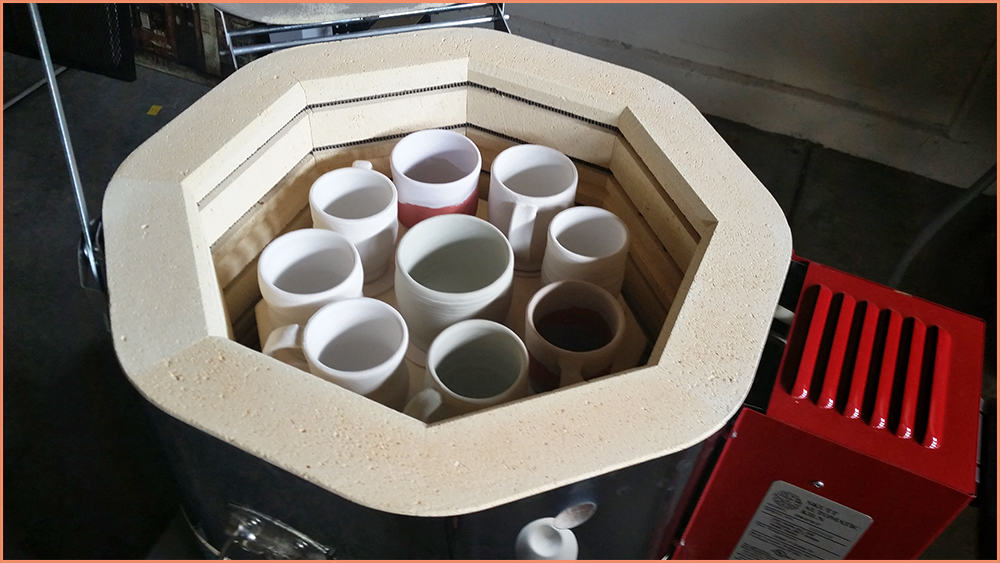

At the same time, you’ll want to think about efficiency. An 8-sided Kiln will fire 10-inch bowls, and so will a 10-sided Kiln. But the 8-sided Kiln will do so more efficiently. Remember, smaller Kilns will heat and cool faster. If you want shorter firing cycles, 8-sided Kilns are better than 10-sided ones.
Here is the lowdown on “standard” Kiln sizes and what they’re good for:
Up to 9 x 11 inches:
If you want to design little delicate bits of pottery, you can make do with smaller Electric Kilns. Many test Kilns are the perfect size for small projects.
They don’t take up much space or have excessive power requirements. Plus, you can carry them around wherever you go. Most test Kilns come in a 9-by-11-inch size. These are also good for firing beads, small items, or doll parts.
18 by 18 inches:
If you make small pieces every other weekend, this is a good-sized Kiln for you. The 18-by-18-inch footprint is a good Size for a Kiln for hobbyists.
As long as you’re not stuffing your Kiln with a large number of pieces, you’ll find a good use for this size. You can easily make a few units of slightly bigger pieces, like plates, bowls, and pots, in this one.
23 by 27 inches:
The 23 by 27-inch Kiln is the most popular size. The average Potter will find it a good size for firing up tall pots or a large number of plates and bowls. This size is an excellent addition to a Home Pottery Studio. But it is still not the ideal production size.
29 by 27 inches:
If you want to set up an Electric Kiln for your business, you’ll find the 29-by-27-inch Kiln ideal. These Kilns are designed for large-scale production. In it, you should be able to cast several 24-size jugs or 10-inch oval dishes for your Pottery business.
Shape:
You’ll also want to think about whether to get a Round or Square unit. Of course, you may prefer the efficiency of a square Kiln with certain types of ware. But the cost difference between the square and round Kilns can be significant. It is up to you to decide whether or not the compromise in shape is worth the cost savings.
Things to Consider
Don’t forget to think about the dimensions of the largest piece you want to fire before you buy.
How many pieces do you want to move through in a set period of time? Also, think about how you expect your needs to change or grow in the next five years.
Do you intend to fire a few large loads or several small ones?
In general, larger kilns have a lower cost per cubic foot of firing space. Those who have some experience with buying Kilns will tell you to buy a larger Kiln than you need now because you’re very likely to outgrow it later.
Also, make sure that any top-loaded Kiln you’re buying doesn’t come with a height disadvantage.
You may find that you have trouble reaching into the bottom of deep 10 and 12-sided Studio Kilns. Visiting a studio to test these Kilns before you buy is a good idea.
An alternative to too-deep Kilns is a wide but shorter 22-inch, 12-sided Kiln.
If you do end up buying a kiln that is too deep because you get a good deal on it, you could always place an accessible shelf on the bottom, held up by posts.
Step 3: What kinds of Ware do you intend to fire?
The size of the Electric Kiln you buy will also depend on the type of wares you intend to fire in it. If you want to work with high-fire ceramics and porcelain, you will want your Kiln to reach high maximum firing temperatures.
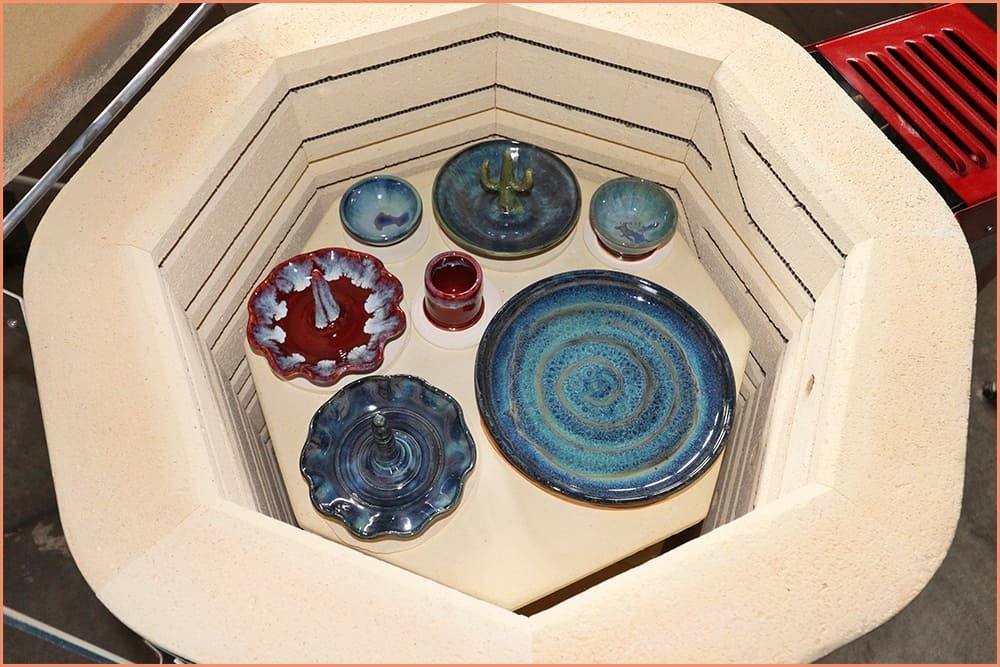
Typically, larger kilns reach higher temperatures. While a lot of small Kilns can also reach cone 8 and cone 10, the larger kilns achieve these temperature ranges most efficiently and consistently.
But if you need larger, industrial-level production volumes of 15 to 20 cubic feet or more, you’d best go for a Gas Kiln. Laying out the electrical lines for such large Kilns can be more expensive than for gas-run units.
The maximum firing temperature is a very important consideration
Some Kilns will fire up to 1832 degrees F (1000 C) only, while others will fire up to 2345 degrees F (1285 C). There is a whole variety of maximum temperatures in between.
To decide what temperatures to work with, you need to consider the materials you’re using. You should also consider what the pieces will be used for. If you intend high-firing projects, you’ll probably need your kiln to reach maximum firing temperatures of cone 8 (2280 F- 1249 C) to cone 10 (2345 F- 1285 C).
Of course, if you want to work on a number of Cone 10 firing projects, you should also ensure the Kiln has the right thickness of walls and elements for long life.
Step 4: Consider the power supply available
The power supply is an important consideration when you buy an Electric Kiln. You’ll have to think about whether your existing home or studio supply will be enough for the Kiln you’re eyeing.
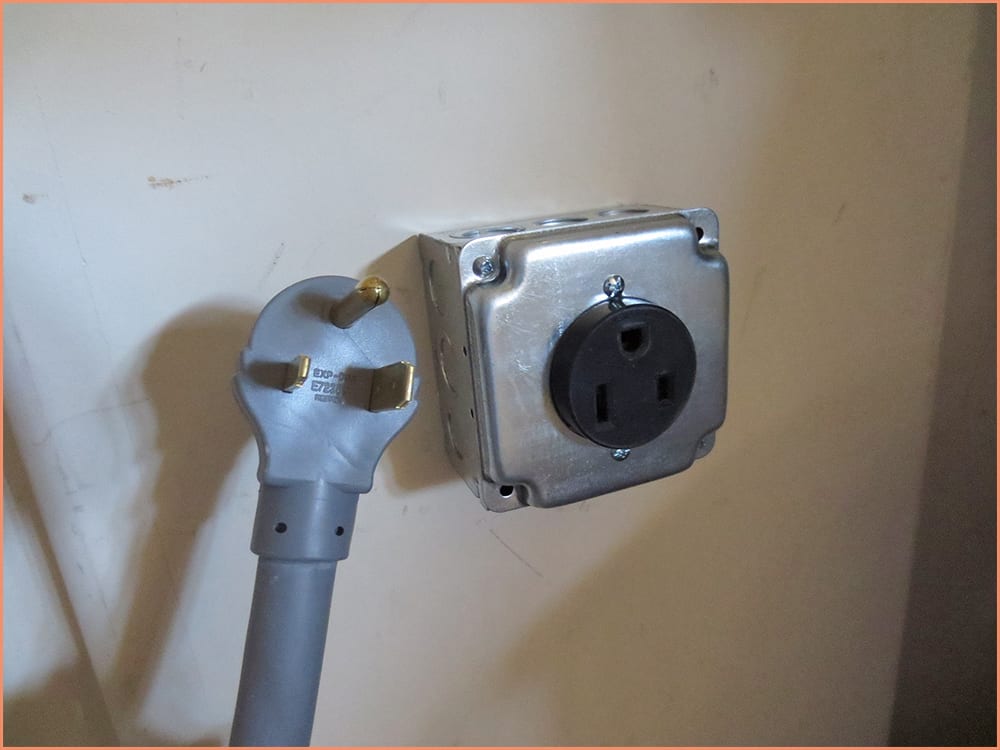
Install your Kiln as per the manufacturer’s instructions and your local fire and electrical safety codes. That is the area you never want to get cheap on.
Using a qualified technician keeps your insurance coverage valid, just in case something goes awry. When it comes to electricity, you do NOT want to take any chances.
Before you purchase an Electric Kiln, I strongly suggest having a Licensed Electrician inspect it to ensure you can safely operate the kiln you are considering. For this reason, I have found that Home Advisor is an excellent choice for hiring an Electrician to ensure the safe and correct installation of any wiring, breaker boxes, or outlets.
After signing up for HomeAdvisor, you will be connected with multiple contractors in your local area.
You will then be able to ask your contractors questions to see if your Kiln is compatible with your electrical system before even setting up an appointment.
I had my Garage wired for my Skutt 818 Kiln, and it took less than one hour.
If you are getting new wiring to accommodate your kiln, you should consider wiring for one size larger than the Kiln you’re looking at. That way, your pottery studio will be future-proof, at least for a while.
Some people wonder whether a three-phase model is better than a one-phase model. The difference between these two types of Kilns only lies in their infrastructure. One is not better than the other. You have to make sure that you have the right kind of Power and Outlet for the Kiln you’re buying.
Most homes have single-phase electrical service. But if you have ‘three-phase,’ it means the service consists of four wires, and not three. Three-phase service is usually 208 or 220/240-volt. An electrician can help you convert from three-phase to single-phase, or you can get a three-phase kiln.
It’s important to match the Kiln’s requirements to the power supply. Doing so will help your Kiln last longer. For instance, if your kiln requires 208 volts but your supply is 240 volts, it can reduce the life of the switches and kiln elements.
If, on the other hand, you supply less power than the Kiln needs, it may not reach the maximum rated temperature during a firing.
Step 5: Write down your budget
Now that you have some idea of what size Kiln you’re looking for and what types of projects you’re looking for, you can start comparing prices. It’s a good idea to set a budget. Kiln costs are typically driven up by factors such as brick material, wall thickness, front-loading or top-loading design, size, and maximum firing temperatures.
Costs are also driven up by features such as controllers, and whether they are manual or automatic. Most modern Kilns are automatic.
But you should note that even with automatic Kilns – digital or mechanical – you’ll need to experiment and figure out how your choice of ware responds to firing and the ideal process for consistent results.
Digital Kilns:
Typically they use a system of transformers and relays. If they are designed well, they tend to be more accurate and reliable than manual Kilns. They are also reasonably easy to repair.
Some people, however, think that mechanical Kilns are even more reliable than digital Kilns. In both cases, however, you need to control the shut-off time.
Some Kilns come with Touchscreen Controllers that have special safety features, programmable slots, and more. It is up to you to decide how far you want to go with these extras. Features like built-in Wi-Fi for remote monitoring can also drive costs up. But you may not find such features necessary.
Finally, don’t forget that when you’re budgeting for your Kiln, you may also want to factor in the cost of firing your Kiln in the long run. Are you planning large-scale production? If so, you may want to go for the most efficient Kiln in terms of volume, not just the cheapest model.
Sometimes, it may be more cost-effective to buy an efficient, well-sealed, and insulated model designed for studio production.
Step 6: Decide if you want a Top-loading or a Front-loading unit


An important decision you have to make is whether to buy a Top-loading or a Front-loading Kiln.
Front-loading Kilns:
Front-loading Kilns are the most convenient to use for obvious reasons. You don’t need to bend to reach into the compartment when loading ware for firing, as you must with top-loading Kilns. Generally, Front-loading Kilns are built with walls that are 4.5 inches thick.
But Front-loading Kilns are not usually affordable for beginners. They can be much more expensive than the more popular Top-loading models. But if you can afford it, a well-made Front-loading Kiln can make a huge difference to your ceramics experience.
Top Loading Kilns:
Top loading Kilns are the most popular and affordable. The walls of top-loading kilns are typically 2.5 inches thick, but 3-inch bricks are also available. You need fewer bricks in the top-loading models. This lowers costs since the bricks are the most expensive elements of a Kiln.
Step 7: Should you get a manual or automatic kiln?
With Manual Kilns, you will need a Kiln Sitter or a limit timer. You may find many used Electric Kilns on the market that need such a system, and you can place a junior cone in the Kiln Sitter to help you control firing times. You can also set the backup timer for around 10 to 14 hours for good measure.
Usually, with Manual Kilns, you should start the Kiln with all switches set to the lowest setting. There is no computer or digital monitor to tell you when you need to turn up the heat. Note that Kiln Sitters are best used with ceramics. Many Cress and Paragon models use the Kiln Sitter to turn off the unit, but you can use the switches to turn the Kiln up.
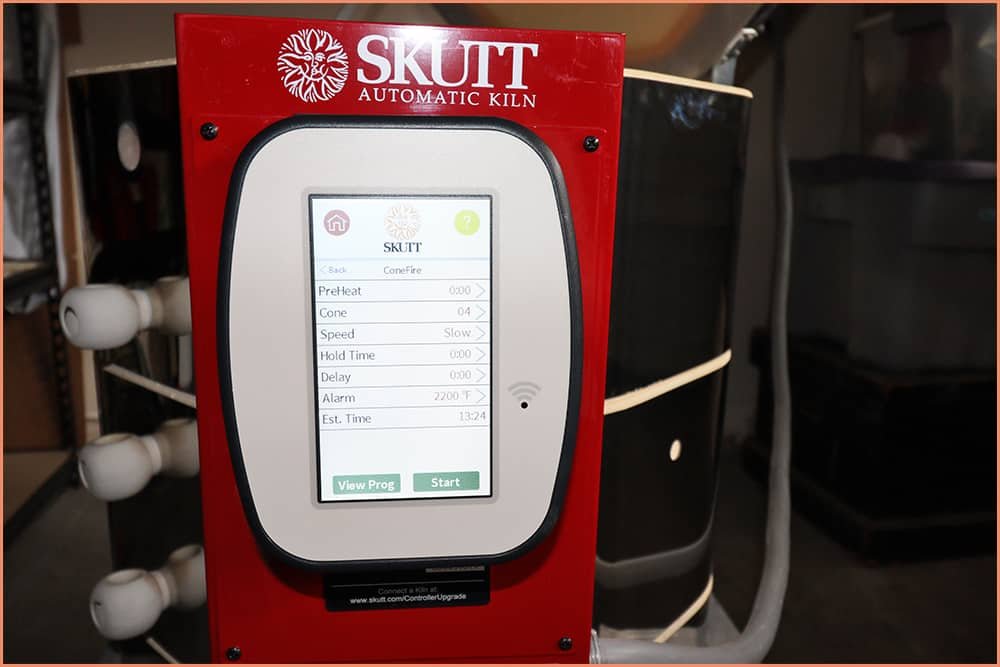
Automatic Kilns usually have computer controllers, and some Kilns come with Touchscreen Controllers. Usually, with presets that you can use quickly. These presets are also easy to program. You can micro-control the firing process by choosing factors such as a candling period, a delayed start, a temperature soak, and more.
Most Potters today find automatic Electric Kilns most convenient. You can sync many controllers to your phone and monitor processes from afar – there’s no need to get up close if you don’t want to.
Note that many Kilns – like some Olympic models – come both with Electronic Controllers as well as backup Kiln Sitters. The choice is up to you.
Step 8: Firebrick or ceramic fiber?
Most kilns use insulating firebrick. Firebrick is more long-lasting than fiber. This durability usually comes at the cost of longer heating and cooling times. Fiber bricks tend to heat up and cool faster. In some situations, you’ll want fiber bricks. But in general, firebricks are the better option for most potters.
In brick Kilns, it is easy to replace elements. The elements are usually placed in grooves along the walls. With fiber, the problem is that elements are often embedded in the fiber. When it’s time for replacement, you will need to replace the fiber chamber altogether. Note that fiber bricks are usually easier to repair than firebricks.
Step 9: How thick should the insulating firebrick wall be?
When researching Kilns, you’ll find Kiln bricks typically come in two thicknesses. Some Kilns have 2.5-inch bricks. Others have 3-inch bricks. What is the best brick thickness for a Kiln? It depends on the balance between heat absorbed and heat lost.

The thicker the brick, the more heat it will absorb and retain, and for longer. Also, a slower cool-down. Thicker bricks are also good when you’re planning a long firing or a soak.
But for most uses in the low-firing to medium-firing ranges, 2.5-inch bricks are good enough. The energy savings in thicker bricks are usually not worth the extra cost.
You’ll find that some Kilns come with extra insulation between the stainless steel cover and the bricks. The extra expense of these models isn’t especially worthwhile unless you’re planning very high cone 8 to cone 10 temperature firing for porcelain.
Step 10: Single-piece or sectional Kiln?
Another factor you may want to think about is the Kiln design. There is a major advantage in buying a sectional kiln. You will be able to move it around and through doors with great ease.
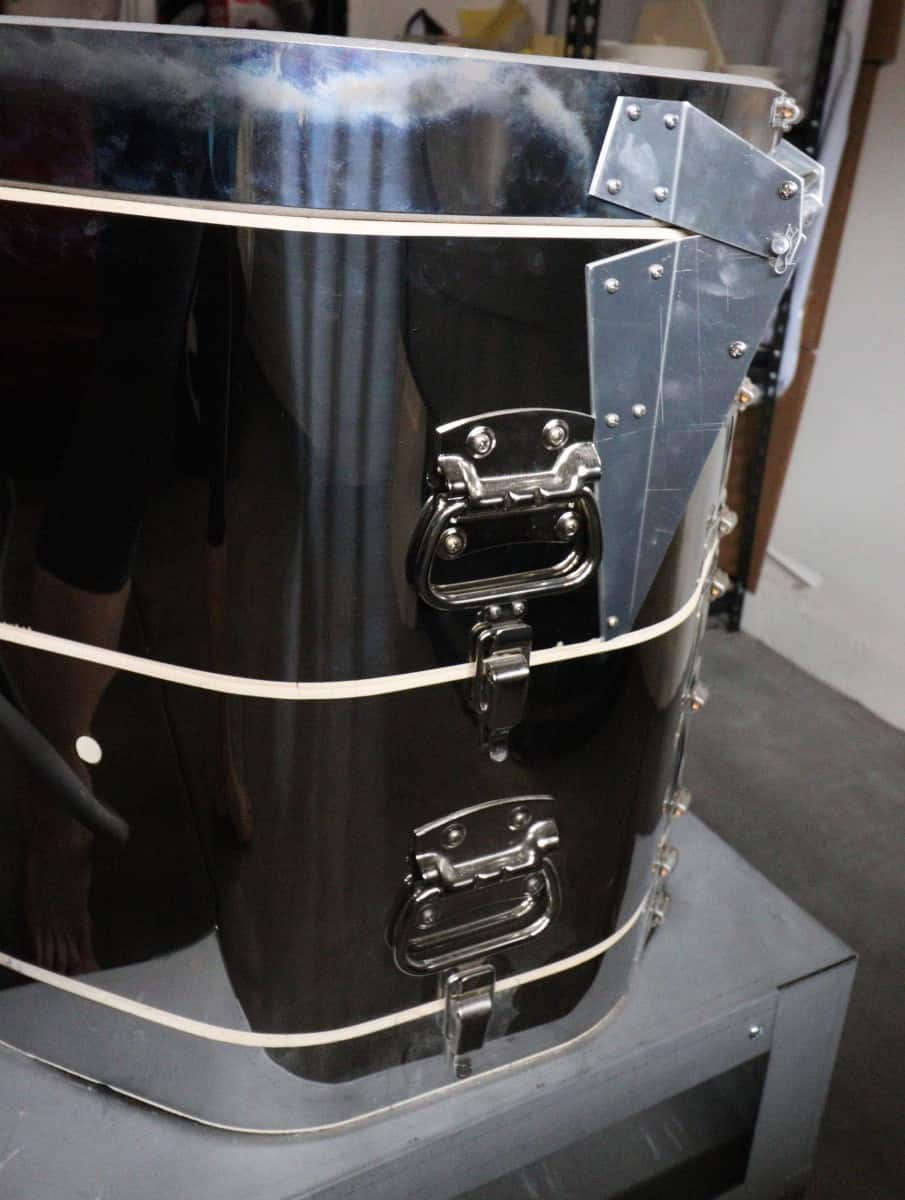
It’s also easier to repair Kilns that have a modular design. Instead of replacing the entire Kiln body, you can also replace just a single faulty section of it. Sectional Kilns can usually be taken apart quite easily.
But the biggest disadvantage of sectional bricks is that there is no stainless steel to reflect heat from the joints. There is a little more heat loss as a result, as compared to heat loss from single-piece Kilns with a seamless stainless steel body.
Also, there is a chance that you will damage parts when you take the Kiln apart to transport it. Dismantling an electric kiln may weaken the seal between sections, leading to energy leaks.
Step 11: What elements are the best?
The elements in the thermocouple are critical to the firing process. They work as thermometers and send data to and from the controllers. You’ll find that most elements can last through 150 to 300 firings. Of course, the longevity of the elements also depends on what wares are being fired.
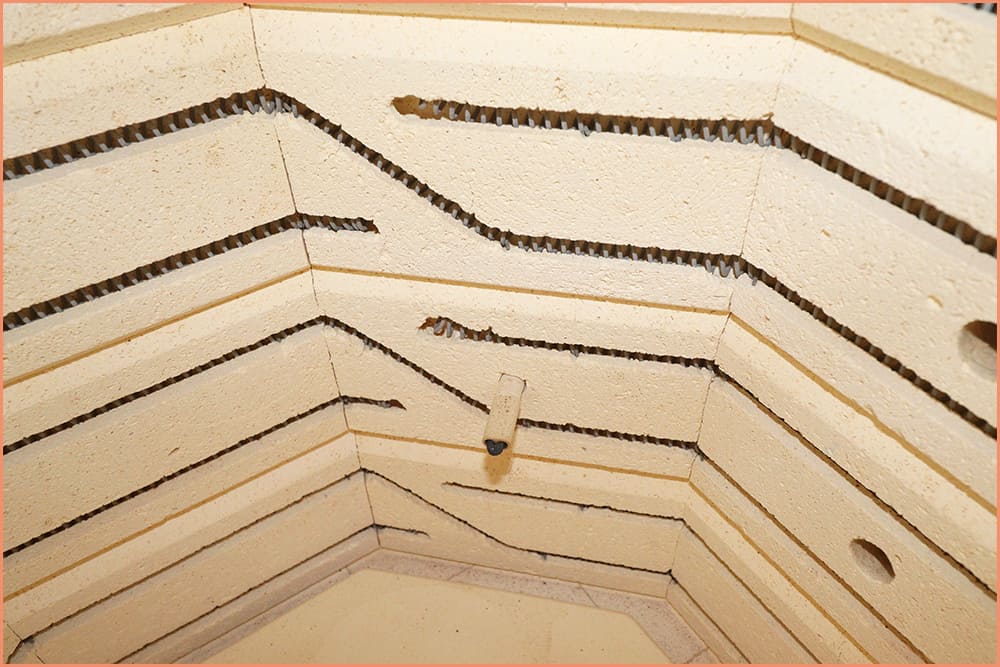
Firing often at Cone 10 can wear Kiln elements down much faster. Don’t panic if your first element at regular Cone 10 firings wears out after thirty to fifty firings. Most Kiln makers use the same wire for elements.
Newer APM elements are available with some models. These are expensive and tend to last longer. If you fire to cone 10 often or use crystal glazes. An APM element will ensure your unit runs for much longer.
Want to know more about buying a Kiln? Read Buying a Pottery Kiln | Facts Features and What to Consider.
You can also go to this 21 Kiln Questions Answered Article to help you on your Kiln journey.
Summary
Here are the key takeaways from this article:
- Buy an Electric Kiln that fits in your home or studio with proper ventilation and sufficient clearance on all sides. Measure the space available, if you have to, before you shop.
- Small Kilns are more energy-efficient, but they won’t fit larger projects. Think about the shape, size, and types of ware you want to fire when you choose a size. A standard Kiln may be too deep for some people. Don’t forget to plan for the future.
- Matching the available power supply and the Kiln outlet is important. Have an electrician check your power supply and outlet and upgrade it if necessary.
- Consider not buying some of the more expensive add-ons and upgrades that can increase your Electric Kiln price.
- Decide whether you want a 2.5-inch-thick firebrick or a thicker one for higher-temperature projects. 3-inch firebricks are good for Cone 5 to Cone 10 firing and are more energy-efficient. Note that thicker bricks can increase the cost of your kiln. Fiber bricks can be good for quickly producing lots of fused work.
- Top-loading Kilns are more popular and cheaper than front-loading Kilns, which are easier to load. Round Kilns are cheaper, while square Kilns can be loaded more efficiently.
- Decide if you are willing to pay for the greater accuracy of automatic digital Kilns over manual Kilns. Consider a Kiln with both an electric controller and a backup sitter for greater control over firing time.
- APM elements can increase cost, but they are good only for Cone 10 firing and crystal glazes. You won’t see any difference from regular elements if you plan low-fire projects.